Bevy Irie
Trust-first website for a Lagos property manager serving landlords abroad, with private visitor analytics. A client project: Sameem worked on it as a full-stack engineer.
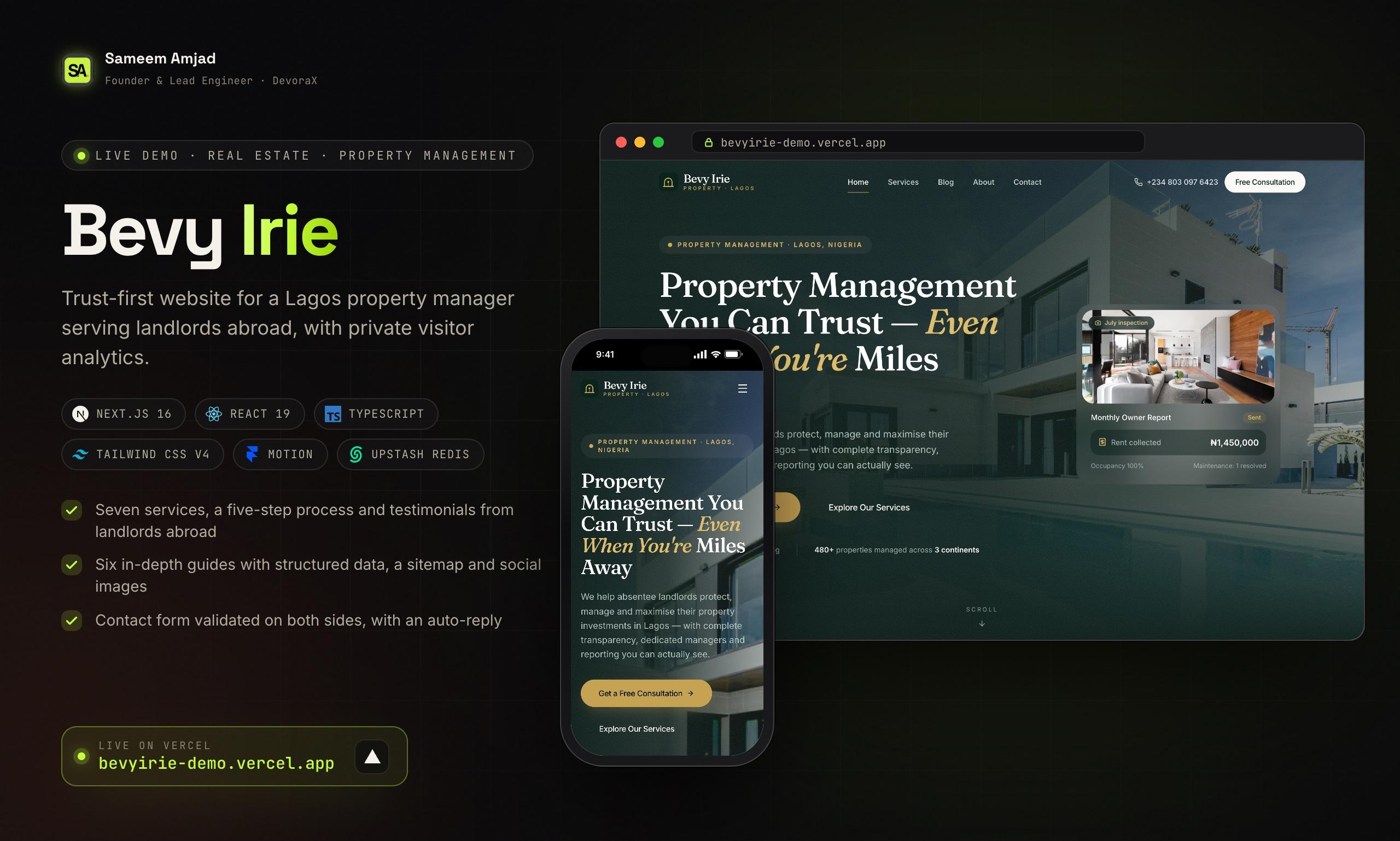
Facts about the build and who it was for. Any figure here is shown on a public store listing or site linked on this page. See how we present portfolio work.
Walkthrough
Screens
Project Story
Landlords abroad hand their property, rent and tenants to a company they may never meet, so the website has to earn that trust on its own: clear services, a visible process, proof from other landlords and an easy way to reach a person. The owner also wanted to see where visitors come from, without an analytics subscription and without collecting personal data.
Ten services, each with what's included and a direct way to enquire; a five-step onboarding process, testimonials from landlords abroad, compliance standards and an FAQ; six in-depth guides for absentee landlords, with structured data, a sitemap and social images; a contact form checked in the browser and on the server, with an automatic reply; WhatsApp and phone on every page, a cookie choice and support for reduced motion; and a private owner dashboard behind a passcode showing views, visitors, countries, pages, devices and sources, with no IP addresses stored.
Live demo of the website and the owner dashboard, which starts with two weeks of sample visits, with a 2-minute walkthrough recorded on it.
Project Details
Bevy Irie's website is for a Lagos property-management company whose clients are landlords living abroad, in London, Houston or Toronto. It explains ten services, shows a five-step onboarding process, carries six guides for absentee landlords and turns visits into enquiries, and a private dashboard shows the owner who visits and where they come from, with no IP addresses stored. It is a client project: Sameem worked on it as a full-stack engineer, on Next.js 16 and React 19 with Upstash Redis for the analytics. The live demo is linked from this page, with a 2-minute walkthrough recorded on it.
Tech Stack
Where to See It
Opens the project’s page on the demo hub in a new tab, with any logins the demo needs.
Category
Next.js & Upstash RedisBevy Irie is a website for a Lagos property-management company whose clients are landlords living abroad, in London, Houston or Toronto, who hand a property and its tenants to a company they may never meet. Bevy Irie is a client project: Sameem worked on it as a full-stack engineer for a client. The site explains each service and what it includes, shows a five-step onboarding process, testimonials, compliance standards and an FAQ, and adds six guides for absentee landlords, with WhatsApp and phone on every page and a contact form checked in the browser and on the server. Behind a passcode, a private owner dashboard shows views, visitors, countries, pages, devices and sources, kept in Upstash Redis with no IP addresses stored. The demo is at demoprojectsforclients.sameemamjad.com/projects/bevyirie, and a 2-minute walkthrough of the website and the owner dashboard is on this page.
What you can check
- Live demo on sample data: demoprojectsforclients.sameemamjad.com/projects/bevyirie (the website and the owner dashboard)
- A 2-minute walkthrough of the website and the owner dashboard on this page, recorded on the demo
- The demo dashboard starts with two weeks of sample visits, and a visitor's own page views appear at the top within seconds, by country only
Each item points to something public: a store listing, a live site or a demo build. See our terms for how we present portfolio results.
What problem was the Bevy Irie website built to solve?
A landlord who lives in London, Houston or Toronto and owns property in Lagos has to hand the property, the rent and the tenants to a company they may never meet. Most of what they learn about that company before getting in touch comes from its website, so the website has to do the work a visit to the office would normally do.
That shaped the first half of the brief: explain the services plainly, show how the company works, offer proof from other landlords and make it easy to reach a person. The second half came from the owner, who wanted to see where visitors come from without paying for an analytics subscription and without collecting personal data.
Bevy Irie is a client project: Sameem worked on it as a full-stack engineer for a client. The public website and the private owner dashboard are one Next.js app.
How does a website earn the trust of landlords who live abroad?
When a service is bought from a distance, buyers tend to look for signals that are hard to fake, such as a process they can follow and a real person at the other end.
On the Bevy Irie site each service lists what is included and has a direct way to enquire, so a landlord can match the offer to their own property. The home page sets out a five-step onboarding process, from booking a consultation through a property assessment, a management strategy and monthly reporting to maximising returns, so a reader can see what happens after the first call. Testimonials from landlords abroad, a compliance standards section and an FAQ follow; the testimonials are the company's own content. The FAQ opens with the question a landlord abroad asks first: how will I know what is happening with my property?
WhatsApp and phone links sit on every page. For clients in other countries, a message app is often the easiest way to reach a business across time zones.
How do the guides and structured data help landlords find Bevy Irie?
The site carries six in-depth guides for absentee landlords, among them a guide to managing property in Lagos from abroad and a playbook for screening tenants remotely. Guides like these answer the questions a landlord researches before choosing a manager, and they show competence in a way a services page cannot.
Each page also describes itself in JSON-LD, the structured data format search engines read. The business is marked up as a real estate agent, the services as an offer catalogue, the FAQ as questions with answers and each guide as a blog post with a breadcrumb trail. Structured data helps search engines and AI tools understand a page without guessing from its layout, though it guarantees no particular search result.
A sitemap lists every page and guide, and Next.js generates branded social images, so a link shared in WhatsApp or on social media shows a proper preview card.
How does the contact form check an enquiry?
The contact form asks for a name, an email address, an optional phone number and property address, the service of interest and a message. It is built with React Hook Form and a Zod schema, and the same schema runs twice: in the browser, so mistakes show field by field as the visitor types, and again in a server action, because anything sent to a server can bypass the browser. Defining the rules once means the two sides cannot disagree about what a valid enquiry looks like.
A hidden honeypot field catches simple bots. People never see it, while bots tend to fill in every field, so a submission with that field filled is accepted quietly and dropped.
The form is built to send the team a notification and the enquirer an automatic reply, so a landlord in another time zone knows the message arrived. In the demo every field is checked the same way, but nothing is sent.
Why build private visitor analytics instead of using an analytics service?
The owner wanted to know where visitors come from without an analytics subscription and without collecting personal data. Hosted analytics tools usually set their own cookies and collect far more than a small company reads, all of which then has to be explained to visitors.
This owner's questions are simpler: how many people visited, from which countries, which pages they read, on what devices and from which referring sites. Answering them needs only a small record per page view, written and read by the site's own code.
The trade-off is scope. A dashboard built for one owner answers fewer questions than a full analytics product, and it has to be maintained along with the site. Here that is acceptable, because collecting less is part of what the site offers its visitors. The records are kept in Upstash Redis, a hosted Redis database the app reaches over HTTP.
How does the site record a visit without storing IP addresses?
On each page change, a small script sends a beacon to the site's own API route with the path, the referring site, the browser language and the time zone. Browsers deliver beacons in the background, so the page never waits for analytics.
The server then trims what it receives. Query strings and fragments are removed from the path, so anything placed in a URL is not stored, and the referrer is cut down to its hostname. Device, browser and operating system come from the user agent, and the country from a header the hosting platform adds to each request. The admin area and the API are never tracked.
To count distinct visitors, the server makes a short one-way hash of the IP address, the browser string and the date. The same visitor counts once per day, the hash changes the next day, and the IP address itself is never written down. Each visit goes to the front of a list in Upstash Redis, trimmed to a fixed length so storage stays bounded. In the demo, visits are recorded by country only.
What happens when a visitor declines cookies?
A cookie banner offers a choice to accept or decline, and the choice is remembered in the visitor's browser. Before sending each page-view beacon, the tracking script checks it. If the visitor has declined, no beacon is sent, so the visit never reaches the server.
The tracker itself sets no cookie, since it relies on the daily hash described above. Honouring a decline anyway means the banner's promise covers the analytics too. A consent banner only means something if the tracking code reads it, and here the check sits in the same few lines that send the beacon, so the two cannot drift apart.
What does the owner dashboard show, and how is it protected?
The owner dashboard sits behind a passcode. It shows total views, unique visitors, views today and page views in the last 15 minutes, above a two-week chart of daily traffic. Ranked lists break visits down by page, country, device, browser and referring site, and a table shows the latest visits. The dashboard is read-only, so there is nothing to delete.
The passcode is checked on the server with a constant-time comparison after a short delay, which slows guessing and reveals nothing through timing. A correct passcode sets a signed, HTTP-only session cookie with an expiry, and the dashboard checks that session on the server before reading any data.
A single shared passcode suits a dashboard with one owner; teams usually need individual accounts, so access can be withdrawn person by person. DevoraX holds no security or compliance certifications.
Where can you see Bevy Irie?
The demo is a separate copy running on sample data. From demoprojectsforclients.sameemamjad.com/projects/bevyirie a visitor can open the website and the owner dashboard, and the hub page lists the demo logins. On the website you can read the services, the onboarding process, the guides and the FAQ, and try the contact form, which checks every field but sends nothing.
The dashboard starts with two weeks of sample visits, and your own page views appear at the top within seconds, shown by country only. Declining cookies stops the page-view tracking entirely.
This page also carries a 2-minute walkthrough of the website and the owner dashboard, recorded on the demo.
Why this stack
- Next.js 16 + React 19 + TypeScript: one app serves the public pages, the tracking API route, the contact form's server action and the private dashboard. Pages render on the server, so the text, metadata and structured data are in the first HTML that crawlers and link previews read. TypeScript gives the visit record one shared shape, used by the tracking route, the store and the dashboard.
- Tailwind CSS v4 + Motion: Tailwind holds the brand's greens and golds as design tokens, so every page draws on the same palette. Motion handles the reveals and the cookie banner, and it is set to follow the visitor's reduced-motion preference, so slides and scale-ins are skipped for people who ask for less movement while gentle fades remain.
- React Hook Form + Zod: React Hook Form keeps the contact form responsive and shows errors field by field. Zod defines the rules once as a schema; the browser uses it through a resolver, and the server action parses the same schema before anything is sent, so the two can never disagree.
- Upstash Redis: a hosted Redis database reached over HTTP, which suits serverless functions that cannot hold a database connection open between requests. A Redis list with push and trim fits an append-only visit log, and the data lives outside the app, so it survives redeploys.
- JSON-LD + sitemap: Next.js generates the sitemap, robots rules and social images from the same data as the pages, so a new guide appears in the sitemap without extra work. JSON-LD describes the business, its services, the FAQ and each guide in schema.org terms that search engines and AI tools read directly.