Pastel Marketplace
Antiques and vintage marketplace on web, iOS and Android. Sameem is a Software Engineer at Pastel (since April 2026) and works on its iOS marketplace app.
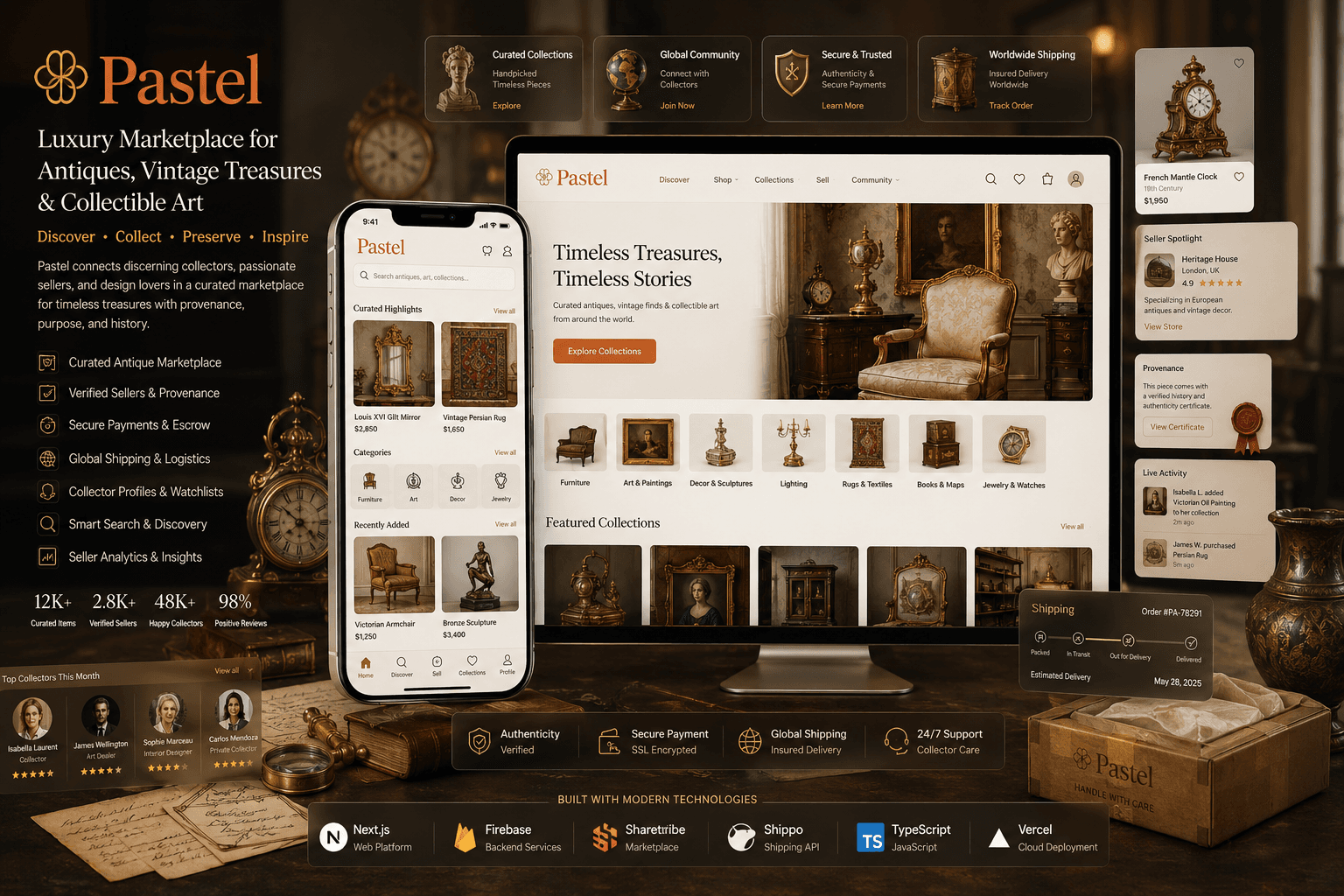
Facts about the build and who it was for. Any figure here is shown on a public store listing or site linked on this page — how we present portfolio work.
Project Story
Antiques sellers and collectors needed a secure and trusted platform to connect globally and ethically trade valuable pieces.
Pastel runs on Sharetribe. Sameem's part, as a Software Engineer at Pastel since April 2026, is the iOS marketplace app.
Live at mypastel.com, on the App Store as Pastel: Antique Marketplace, and on Google Play.
Project Details
Pastel is an antiques and vintage marketplace built on Sharetribe, with the web marketplace at mypastel.com and apps on iOS and Android. Sameem joined Pastel as a Software Engineer in April 2026 and works on the iOS marketplace app. The iOS app first launched in November 2025, before he joined.
Tech Stack
Where to See It
Category
Sharetribe & iOSPastel is a US-based marketplace for antiques, vintage decor and collectibles, running on Sharetribe, where independent sellers list one-of-one pieces and host live shopping shows. Sameem has been a software engineer at Pastel since April 2026 and works on its iOS marketplace app, which first launched on the App Store in November 2025, before he joined. Pastel can be used today on the web at mypastel.com, on the App Store as Pastel - Antique Marketplace, and on Google Play.
What you can check
- Website: mypastel.com
- App Store: Pastel - Antique Marketplace (id6753628917), first released November 2025
- Google Play: Pastel (com.anoptico.pastel)
Each item points to something public: a store listing, a live site or a demo build. See our terms for how we present portfolio results.
What is Pastel?
Pastel is a marketplace for antiques, vintage pieces and collectible art. Buyers browse listings by category (art, jewellery, decor, furniture, kitchenware, timepieces and maps among them), follow the shops they like, save pieces to a wishlist and buy directly from independent sellers. Dealers and collectors who want to sell apply from inside the app.
What sets it apart from a plain listings site is live shopping. Sellers host real-time shows in which buyers can see a piece up close, ask questions and buy it without leaving the stream, and short videos sit alongside the catalogue so a buyer can watch an object before committing to it. Followers are notified when a seller goes live and can set reminders for scheduled shows.
Underneath that is an unusual kind of inventory. Every listing is a single object: there is no restock, no second unit and no stock depth. The App Store listing puts it as "every listing tells a story, with detailed documentation that helps buyers and collectors shop with confidence", and that documentation, together with photographs and video, has to do the work a spec sheet does in ordinary retail.
What does Sameem work on at Pastel?
Sameem joined Pastel as a software engineer in April 2026 and works on its iOS marketplace app: the app buyers use to browse, watch shows, message sellers and check out, and sellers use to manage listings, orders and shipping.
The iOS app was already live when he joined; it first appeared on the App Store in November 2025. His work is therefore on a published app with a release history, where every change has to ship without breaking the version already installed on people's phones, and where the website, the iOS app and the Android app all read the same marketplace.
Pastel's recent App Store release notes (September 2026) show the kind of change a live marketplace app goes through: signing in from Add to Cart or Buy brings the shopper straight back to the same item, the unread-notification badge on the app icon stays accurate while the app is closed, shared listing links carry the item's title, and sellers can save package weight and dimensions and create shipping labels on paid orders.
Why does a one-of-one catalogue change how the app is built?
A conventional shop app assumes a product with variants, stock counts and a price repeated across many identical units. An antiques marketplace inverts each of those assumptions. Each listing is a one-of-one record whose value rests on its history and condition, so the weight of the product sits in media and narrative rather than in attributes.
That makes listing state delicate on a phone. A piece sitting in someone's cart or wishlist may have sold since they last looked, so the app cannot trust what it has cached: availability has to be confirmed against the marketplace at the moment of checkout, and a sold piece has to leave the catalogue cleanly rather than linger with a stock count of zero.
It also changes what a slow screen costs. A collector deciding whether a piece is worth a serious sum judges it almost entirely through photographs and video, so image and video loading is the main performance budget of the app, not an afterthought.
What does Sharetribe handle?
Pastel runs on Sharetribe, a marketplace platform that provides users, listings and transactions as a managed backend. Building on it rather than writing a marketplace engine from scratch puts the riskiest part of the product, money moving between a buyer, the platform and a seller, inside infrastructure made for two-sided commerce.
A marketplace payment is not a simple checkout. In a typical marketplace, money is taken from the buyer, held while the piece is packed and shipped, and released to the seller once the exchange is complete, with commissions, refunds and disputes along the way. Sharetribe models that as a transaction process with defined states and transitions, so the rules are enforced by the platform rather than reimplemented in each app.
For the iOS app this is the useful property. The app reads a transaction's current state from the same Sharetribe marketplace that the website and the Android app use, instead of holding its own copy of the rules. A piece marked sold on the web is sold in the app a moment later, because there is only one place where it can be marked sold.
Firebase sits alongside Sharetribe for the parts a marketplace engine does not cover; profile pictures on the live site, for example, are served from Firebase Storage.
What does live shopping ask of a mobile app?
Live shows turn a catalogue app into a real-time one. A buyer watching a show is doing three things on one screen: watching video, asking questions as the seller talks, and buying a piece before someone else does. Each of those has its own failure mode on a phone that moves between wifi and mobile data, and the purchase has to stay correct even when the video stutters.
Notifications carry more weight than in an ordinary shop app. A "seller is going live" alert is worthless an hour late, reminders for scheduled shows have to fire at the right local time, and the unread badge on the app icon has to match what the buyer finds when they open the app. Shared links have to open the right listing inside the app rather than a generic home screen.
None of that is exotic engineering on its own. The difficulty is that it all runs against one-of-one inventory, where a late notification or a stale screen can mean a buyer misses the only example of a piece they wanted.
How do shipping and seller tools fit in?
Every sale on Pastel is a one-off shipment. A lithograph print, a stoneware beer stein and a giltwood wall mirror share no packaging profile and no obvious carrier, and most sellers are dealers and collectors rather than logistics professionals, so the app has to do much of the reasoning for them.
Seller tools in the app cover that path: saving a package's weight and dimensions, creating a shipping label once an order is paid, and managing orders from the seller panel. Pastel uses Shippo, a multi-carrier shipping API, so rates, labels and tracking come through one integration instead of one per carrier.
Buyers see the other side of the same data: order tracking from purchase to delivery, inside the app where they bought the piece.
Where can you see Pastel?
Pastel is live on three surfaces. The marketplace runs on the web at mypastel.com. The iOS app, Pastel - Antique Marketplace, has been on the App Store since November 2025 (app id 6753628917). The Android app is on Google Play under the package name com.anoptico.pastel.
The iOS app is the part Sameem works on.
Anyone can open the site or install the app and browse the live catalogue of antiques, which is the most direct way to check what is described here.
Why this stack
- Sharetribe — marketplace money movement is a state machine, not a checkout: funds taken from a buyer, held while a piece ships and released to a seller, with commissions, refunds and disputes along the way. Sharetribe's transaction process enforces those rules on the platform, so the iOS app reads a transaction's current state instead of reimplementing the flow or taking custody of funds. The website, the iOS app and the Android app all read one marketplace, which is what keeps a sold piece sold everywhere.
- iOS app on shared marketplace data — the app should hold no rules of its own about what is for sale. With one-of-one inventory, cached availability cannot be trusted at the moments that matter (adding to cart, buying, opening a shared link), so the app has to defer to the marketplace's current state there and spend its own effort on what a buyer actually judges a piece by: photographs, video and live shows that load quickly.
- Firebase — sits alongside Sharetribe for what a marketplace engine does not provide out of the box; profile pictures on the live site are served from Firebase Storage. A managed backend means no file servers to keep running alongside the marketplace.
- Shippo — every antique sale is a one-off shipment with its own packaging profile and best carrier, and sellers are not logistics professionals. One multi-carrier API gives rates, labels and tracking without integrating or maintaining each carrier separately, and lets the app ask a seller for only the package weight and dimensions it needs.