FinTech Mobile App
A cross-platform banking app: a React Native client on a Node.js API for account views, transfers and transaction history.
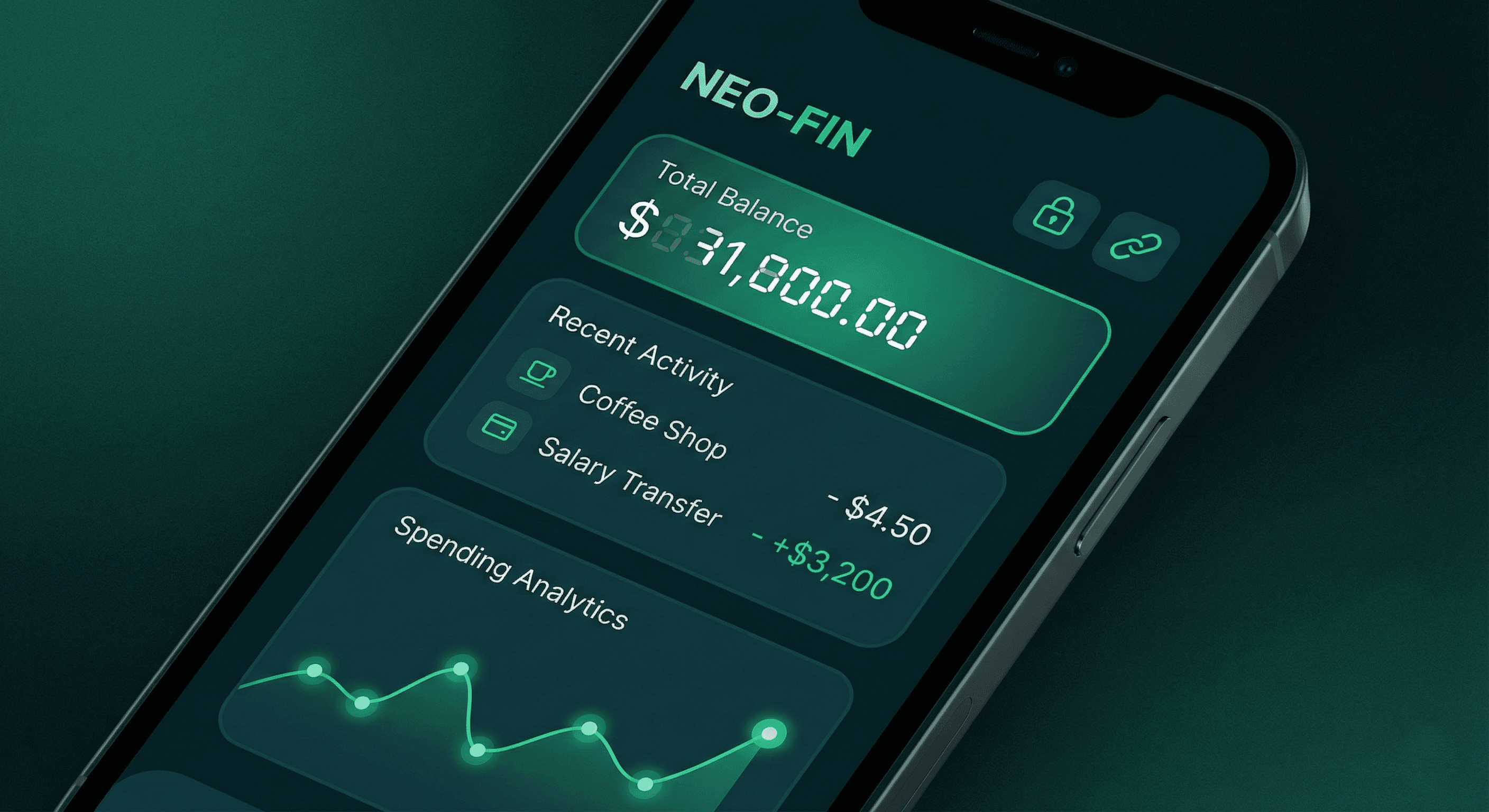
Facts about the build and who it was for. Any figure here is shown on a public store listing or site linked on this page — how we present portfolio work.
Project Story
A banking app has to keep transfers correct and secure on both iOS and Android, on mobile networks where requests time out and get retried.
A cross-platform React Native app on a Node.js backend, with authenticated APIs and real-time transaction handling.
One React Native codebase for iOS and Android over a single Node.js transaction API.
Project Details
Cross-platform banking app with a React Native client and a Node.js backend: account views, transfers and transaction history over authenticated APIs, with transfer requests designed to be safe to retry on unreliable mobile networks.
Tech Stack
Where to See It
No public link for this project
Category
React Native & Node.jsFinTech Mobile App is a cross-platform banking app written in React Native, with a Node.js backend that serves its APIs and handles transactions in real time. The sections below cover the engineering questions a banking app of this shape raises: retries on mobile networks, how balances are stored, what one transfer costs a backend, why a shared codebase matters when the code moves money, what Node.js is and is not good at, and where security decisions have to be made.
What problem was the FinTech Mobile App built to solve?
The problem it addresses is stated in one line: banking apps struggle with scalability, transaction reliability and security across platforms. Four things are named there and none of them is a feature. Scalability, reliability and security are properties of a system rather than items on a menu, and across platforms adds the constraint that whatever is true of the Android app has to be true of the iOS one.
Read together, the three concerns pull against one another, which is what makes the sentence a single problem rather than three. Security adds work to every request, because a credential has to be verified, a session has to be checked and a payload has to be validated before anything is allowed to move money. Reliability adds durable writes, because a system that must not lose a transaction has to record it somewhere that survives a process dying mid-request. Scalability wants the opposite of both, since the cheapest request is the one that does the least. A design that satisfies any one of the three in isolation is easy to produce and easy to defend. Satisfying all three at once is where the engineering sits, and it is why the rest of this write-up reads as a set of properties rather than a feature list.
Why is transaction reliability harder than ordinary request handling?
Most requests in most applications are safe to repeat. Fetching a balance twice returns the same balance. A transfer is different, because the request is the event: running it twice moves the money twice, and the second movement is indistinguishable from the first at the point it arrives. Mobile networks make that more than a theoretical concern. A phone can send a request, lose connectivity before the response returns, and have no way to tell whether the server acted. The app is then holding a question it cannot answer, and the only two options available to it, retry or give up, are both wrong some of the time. The general answer is to make the operation carry its own identity. The app generates a key for the transfer before sending it, the server records that key alongside the result, and a repeat of the same key returns the original outcome instead of producing a new one.
The second half of reliability is how the balance itself is stored. A single mutable number is the obvious representation and the fragile one, because once it is wrong there is nothing left to reconstruct it from. The usual approach in financial systems is to append entries that can never be edited and to derive the balance from them, which gives every figure a history that can be replayed, audited and explained to a customer who disputes it. Concurrency is the related hazard. Two requests that each read a balance, check it is sufficient and then subtract from it will both succeed unless the check and the subtraction happen as one indivisible step, and a retried request on a weak connection makes that race ordinary rather than rare.
What does one transfer cost a banking backend, and when is that cost highest?
Banking traffic is not spread evenly across a day. It follows waking hours, working hours, paydays and month ends, so the busiest minute of a busy day sits well above the daily average. A daily total measures an average rather than a demand, and a system sized against the average is short of capacity at exactly the moments customers notice. Capacity has to be planned against the peak, and the more useful design question is what happens when the peak is exceeded anyway. A backend that queues and slows under overload recovers. One that starts timing out partway through transfers leaves phones unsure whether to retry, which turns a capacity problem into a correctness problem.
The other half of the question is what one transaction costs rather than how many there are. A single transfer in a banking app is rarely a single write. It is an authorisation check, a balance read, one or more ledger entries, an audit record and usually a notification, and any of those can involve a further system. Volume multiplies whatever that chain costs, so the work of scaling is usually spent shortening the chain rather than adding machines to run a long one faster. Durability is the part that resists that. Entries that record money moving have to reach persistent storage before the request is answered, and a write that must be durable cannot be made fast by caching it.
Why does React Native suit a cross-platform banking app?
React Native is the app framework, and cross-platform delivery is one of the stated constraints. The argument for a shared codebase is stronger in banking than in most categories, because the thing being duplicated is not a screen but a rule. If a transfer flow is written twice, once in Kotlin or Java and once in Swift, then validation, rounding, limit checks, error handling and the exact sequence in which a confirmation is shown all exist in two places, and two implementations of the same rule drift apart as each is edited on its own. Drift in a marketing screen is a cosmetic defect. Drift in a flow that moves money is a correctness defect, and it is the kind that surfaces on one platform only, which makes it slow to notice and awkward to reproduce. One codebase removes the category rather than reducing it.
The second property that matters here is access to the platform rather than a wrapper around it. React Native renders through native views and reaches operating system capability through native modules, which is what a banking app needs, because the facilities it depends on are not web features. Hardware-backed key storage, biometric prompts, push registration and certificate handling are all provided by the platform, and an app that cannot reach them cannot use them. The tradeoff is worth naming rather than hiding. A cross-platform runtime adds a layer between product code and the platform, so anything the layer does not expose has to be written natively anyway, and each platform still has its own release process, store approval and permission model.
What does Node.js contribute to a transaction backend, and what does it not?
Node.js is the backend runtime, and the fit rests on the shape of the work rather than on raw speed. An API of this kind spends most of its time waiting: on a database, on an authorisation service, on whatever holds the ledger, on a notification being handed off. Very little of a request is computation. Node handles that profile with a single-threaded event loop, so a connection that is waiting costs a callback rather than a parked thread, and a large number of mostly idle connections does not turn into the same number of thread stacks consuming memory. Mobile apps produce exactly that pattern, since a phone on a cellular network holds a connection open far longer than the server actually spends working on it. A runtime that allocates a thread per request pays for that waiting in memory it cannot use for anything else.
The limit is the same property inverted. One thread means one piece of computation at a time, so anything genuinely CPU-bound blocks every other request while it runs. In a financial backend the candidates are specific rather than hypothetical: password hashing, bulk cryptographic work, statement or report generation, large exports. The standard handling is to move that work off the request path entirely, into worker threads, a separate process or a queue consumed elsewhere, which is a design obligation rather than a defect. The other reason the pairing holds is ordinary. React Native and Node run the same language, which lets a team define an account, a transfer or an error once and share that definition across the boundary instead of restating it in a second language and keeping the two in agreement by hand.
What does a banking app's security model have to assume?
A banking app runs on a device its owner controls, over networks the operator does not, against a server that has to assume both are hostile. Every rule that matters therefore has to be decided on the server, because anything the app is permitted to determine, the app can be made to determine differently. DevoraX, which publishes this page, holds no security certifications and has run no compliance audits.
The practical consequences are well understood and not specific to this build. Secrets do not ship inside a mobile app, because an app binary is distributable and readable. Credentials held on a device belong in the platform's protected key storage rather than in ordinary app storage. Sessions are short-lived and revocable, so a stolen token expires rather than lasting indefinitely. Limits, eligibility and balances are checked again on the server even when the interface has already checked them, since the interface check is a convenience for the user rather than a boundary. Everything that changes money is logged in a form that cannot be quietly edited, which is the same append-only discipline reliability asks for.
Where can the FinTech Mobile App be seen?
There is no public link and no named client: the app has no website, Google Play listing or App Store listing, and FinTech Mobile App is a category label rather than a product name.
The build itself is a cross-platform banking app written in React Native on a Node.js backend, aimed at scalability, transaction reliability and security. The sections above explain the engineering behind those choices: safe retries on mobile networks, how balances are stored, what one transfer costs, why a shared codebase matters, and what the server has to decide.
Why this stack
- React Native is the app framework, and cross-platform delivery is one of the stated constraints. A shared codebase matters more in banking than in most categories, because what gets duplicated is not a screen but a rule: validation, limits, rounding and confirmation order written twice will drift, and drift in a money-moving flow is a correctness defect that appears on one platform only. React Native also renders through native views and reaches platform capability through native modules, which is what hardware-backed key storage and biometric prompts require.
- Node.js is the backend runtime. A transaction API like this is dominated by waiting rather than computation: a database read, an authorisation check, a ledger write, a notification handed off. An event loop suits that profile, since a waiting connection costs a callback instead of a parked thread, and phones hold connections open far longer than the server spends working on them. The limit is the same property inverted, so CPU-bound work such as hashing or report generation has to leave the request path. Sharing one language also lets account and transfer types be written once and used on both sides of the API.
- Security is one of the three concerns this build is aimed at, and it is a property rather than a technology. What a banking app generally requires is a server that trusts neither the device nor the network: authorisation decided server-side, secrets kept out of the app binary, credentials in platform key storage, short-lived revocable sessions and an append-only record of anything that moves money.