AI E-Commerce Ecosystem
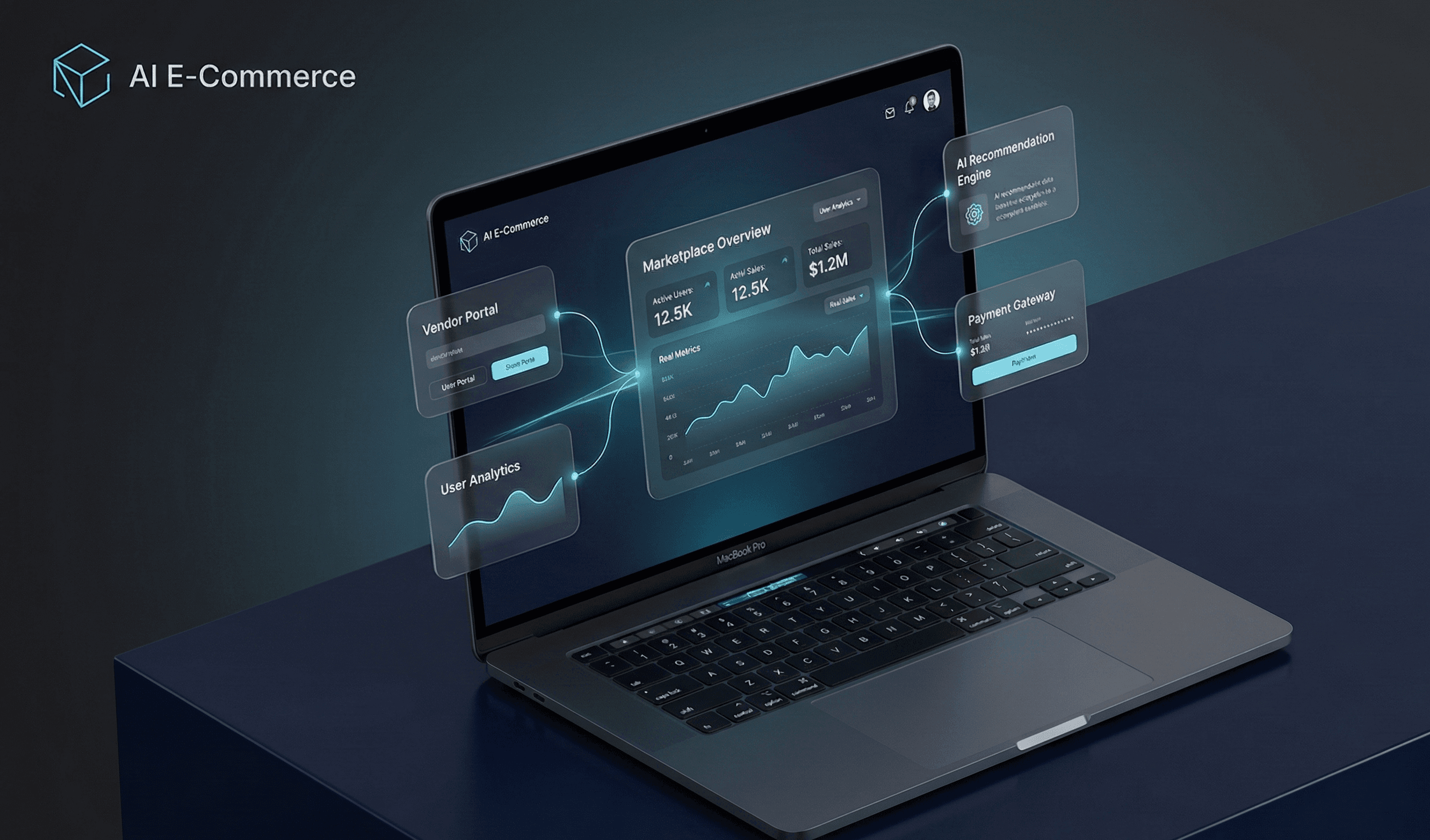
A multi-vendor marketplace build with AI-driven product recommendations, on Next.js with containerised services (Docker, Kubernetes).
Facts about the build and who it was for. Any figure here is shown on a public store listing or site linked on this page — how we present portfolio work.
Project Story
Multi-vendor eCommerce platforms faced performance bottlenecks, poor scalability, and lack of personalized shopping experiences.
Designed a containerized microservices architecture using Next.js, Docker, and Kubernetes with AI-driven recommendation systems.
A multi-vendor marketplace with personalised recommendations and vendor management, run as containerised services on Docker and Kubernetes.
Project Details
Scalable multi-vendor marketplace leveraging AI-driven recommendations and containerized microservices architecture.
Tech Stack
Where to See It
No public link for this project
Category
Next.js & MicroservicesAI E-Commerce Ecosystem is a multi-vendor marketplace with a Next.js storefront, a containerised microservices backend on Docker and Kubernetes, vendor management and AI-driven product recommendations. The sections below explain why a marketplace with many sellers is split into services, what Next.js does on the shopper-facing side, what Docker and Kubernetes each contribute, and what a recommendation system needs from the architecture around it.
What problem was the AI E-Commerce Ecosystem built to solve?
The problem it addresses, in one sentence: multi-vendor eCommerce platforms run into performance bottlenecks, poor scalability and a lack of personalised shopping experiences. The three named deficits are not independent. Performance bottlenecks and poor scalability are the same failure observed at two different moments: one is what a shopper meets on a slow page, the other is what happens to that page when the catalogue, the vendor count or the traffic grows. Personalisation is the third, and it is the one that makes the first two worse, because a recommended set of products is computed per shopper rather than served identically to everyone, and computation per shopper is the most expensive kind of page there is.
The word multi-vendor is carrying most of the difficulty. A single-seller shop has one catalogue, one owner of pricing, one inventory system and one definition of what a product record means. A marketplace has as many of each as it has sellers, and it has to present them as one coherent shop to a shopper who does not care where anything came from. That turns ordinary operations into fan-out. A search request reaches across every vendor's inventory. A cart can hold items from several sellers at once, which means one checkout resolves into several fulfilment obligations and several settlements. A stock level can be written by a vendor's own tooling at the same moment a shopper is trying to buy the last unit. None of these are hard in isolation, and all of them are harder when the number of independent writers is not fixed.
The second consequence of many vendors is that load stops being uniform. One seller running a promotion, uploading a large catalogue or being featured on a home page generates a burst that has nothing to do with the rest of the platform, and in a system where every function shares one process and one database, that burst is felt by everyone. This is the ordinary way a marketplace meets a performance bottleneck: not because any single operation is slow, but because an expensive one and a cheap one are competing for the same resources with no way to tell them apart.
Why split a multi-vendor marketplace into microservices instead of one application?
The backend is built as containerised microservices, and the argument for that split in a marketplace is mostly about independent scaling. Search, catalogue reads, checkout, vendor onboarding, order management and recommendation serving have very different cost profiles and very different traffic shapes. Catalogue reads are frequent, cacheable and cheap. Checkout is infrequent, expensive and must not be lost. Recommendation serving is computational and can degrade to something generic without anyone losing money. When these live in one deployable unit, they scale together, so the only way to add capacity for the busiest of them is to add capacity for all of them. Splitting them lets each one be sized for its own load, which is the difference between paying for the peak of one function and paying for the peak of every function at once.
The second benefit is failure isolation, and it is worth stating precisely because it is often overclaimed. Separating services does not make failures less likely. It changes what a failure takes down with it. A recommendation service that stops responding should leave a shopper able to browse and buy, which is only true if the caller treats its absence as a normal condition with a fallback. The cost side is real and permanent. Every call that used to be a function invocation becomes a network request that can be slow, duplicated or lost, which turns ordering and retries into design problems rather than language features. Data that once sat in one transaction now spans several stores, so consistency has to be arranged deliberately instead of assumed. And the operational surface multiplies: more deployments, more configuration, more places for a request to disappear. Microservices trade a harder runtime for a cheaper rate of change.
What does Next.js contribute on the shopper-facing side?
Next.js is the shopper-facing framework, and its relevance to a marketplace starts with where rendering happens. A catalogue is content that has to be found, so product and category pages need to arrive as complete HTML for crawlers and for any engine that reads a page without executing JavaScript. A cart, a variant selector and a filter set are interactive state that belongs in the browser. Next.js lets both exist in one application by deciding rendering per route rather than per project: a page can be generated ahead of time, rendered on request, or left to the browser, and the choice can differ between the home page, a product page and an account screen. For a shop, that is the difference between being indexable and being fast to interact with, and it removes the usual need to build two frontends.
The second thing a framework like this does in a microservices system is act as the layer where many services become one page. A product page in a marketplace is assembled from several sources: the item itself, the seller, stock, price, reviews and a recommended set. Asking a browser to fetch each of those separately puts the latency of every service on the shopper's connection and exposes the internal shape of the system to anyone who opens the network tab. Doing the assembly on the server keeps those calls inside the network, lets slow or optional parts be handled without blocking the rest, and gives the frontend one contract instead of six. The cost is that this layer is now a dependency in the request path with its own scaling and failure behaviour, which is part of why containerised deployment matters here.
Why does a marketplace like this run on Docker and Kubernetes?
Docker and Kubernetes are the infrastructure this build runs on, and they answer two different questions. Docker answers what a service is: an image containing the application and everything it needs to run, which runs the same way on a developer machine, in a test environment and in production. In a system split into many services, that matters more than it does in one application, because each service can carry its own runtime version and its own dependencies without negotiating with the others. A recommendation service that needs a particular set of numerical libraries does not force that choice on a checkout service. It also makes a deployment an artefact rather than a procedure, which is what allows a rollback to be a change of image reference instead of a re-run of the steps that produced the previous state.
Kubernetes answers where those images run and how many of each. It keeps a declared number of replicas alive, restarts what dies, places containers on machines with room for them, and moves traffic to instances that report themselves ready. For the scalability problem named above, the relevant behaviour is horizontal autoscaling per service: the search tier can grow during a traffic spike while checkout stays where it is, and shrink again afterwards, without a human deciding either time. Rolling updates matter for the same reason, since a marketplace that is always open cannot take a maintenance window to deploy one service. The honest cost is that a cluster is itself a system to run, with networking, storage, resource limits and upgrade cycles of its own, and it is only worth that overhead when there are enough independently scaled services to justify it.
What does an AI recommendation system need from the architecture around it?
The AI in this build is a product recommendation system, and recommendation work makes specific demands of the system around it. The first demand is events. A recommender is only as good as the record of what shoppers viewed, searched, added and bought, which means the platform has to emit those signals reliably and store them in a form that can be read in bulk later. That is a different access pattern from serving a page, and it is one reason recommendation tends to become its own service with its own store: the write path is high volume and append-only, and the read path is analytical rather than transactional.
The second demand is a latency budget. A recommendation shown on a product page has to be produced inside the time that page is being assembled, which is short, while the work that makes recommendations good is expensive. The usual resolution is to separate the two: compute the heavy part on a schedule, offline, and keep the online step to a lookup and a light ranking pass. That is also what lets the feature fail safely, because a precomputed set can be served when the model behind it is unavailable. A marketplace adds a constraint a single-seller shop does not have, which is that recommendations decide which sellers get shown. A system that only promotes what already sells will keep promoting it, so new vendors and new items need deliberate handling rather than whatever the data happens to produce.
Where can the AI E-Commerce Ecosystem be seen?
There is no public link and no named client: the marketplace has no live storefront on the web, on Android or on iOS.
The build is a multi-vendor marketplace with a Next.js storefront, a containerised microservices backend on Docker and Kubernetes, vendor management and AI-driven product recommendations. Next.js, Docker and Kubernetes are the technologies and microservices is the architectural style, and the sections above explain why each suits a marketplace with many sellers.
Why this stack
- Next.js is the frontend framework. A marketplace needs its catalogue to be indexable, which argues for HTML rendered on the server, and its cart and filters to be interactive, which argues for the browser. Next.js decides that per route rather than per project, so a product page and an account screen can render differently inside one application. In a system of many services it also gives the frontend a server-side place to assemble a page from several of them, keeping those calls inside the network.
- Microservices is an architectural style rather than a tool. It suits a marketplace because the functions inside one have incompatible load profiles: catalogue reads are frequent and cacheable, checkout is rare and must not be lost, recommendation serving is computational and may degrade to something generic. Split apart, each is sized for its own traffic instead of everything scaling with the busiest. The cost is permanent: in-process calls become network calls that can be slow or duplicated, and consistency across stores has to be arranged rather than assumed.
- Docker defines what a service is: one image holding the application and its dependencies, running the same way in development and in production. Across many services that isolation is the point, since each can hold its own runtime and libraries without agreement from the rest, and a recommendation service with heavy numerical dependencies does not impose them on checkout. It also turns a deployment into an artefact, so a rollback is a change of image reference rather than a repeated procedure.
- Kubernetes decides where images run and how many of each: replicas kept alive, failed containers restarted, traffic sent only to instances reporting ready. The property that matters against the scalability problem is per-service horizontal autoscaling, letting search grow during a spike while checkout stays as it is. Rolling updates let one service deploy without closing a shop that has no maintenance window. The overhead is that a cluster is itself a system to operate, worth it only with enough independently scaled services.