VoiceDesk
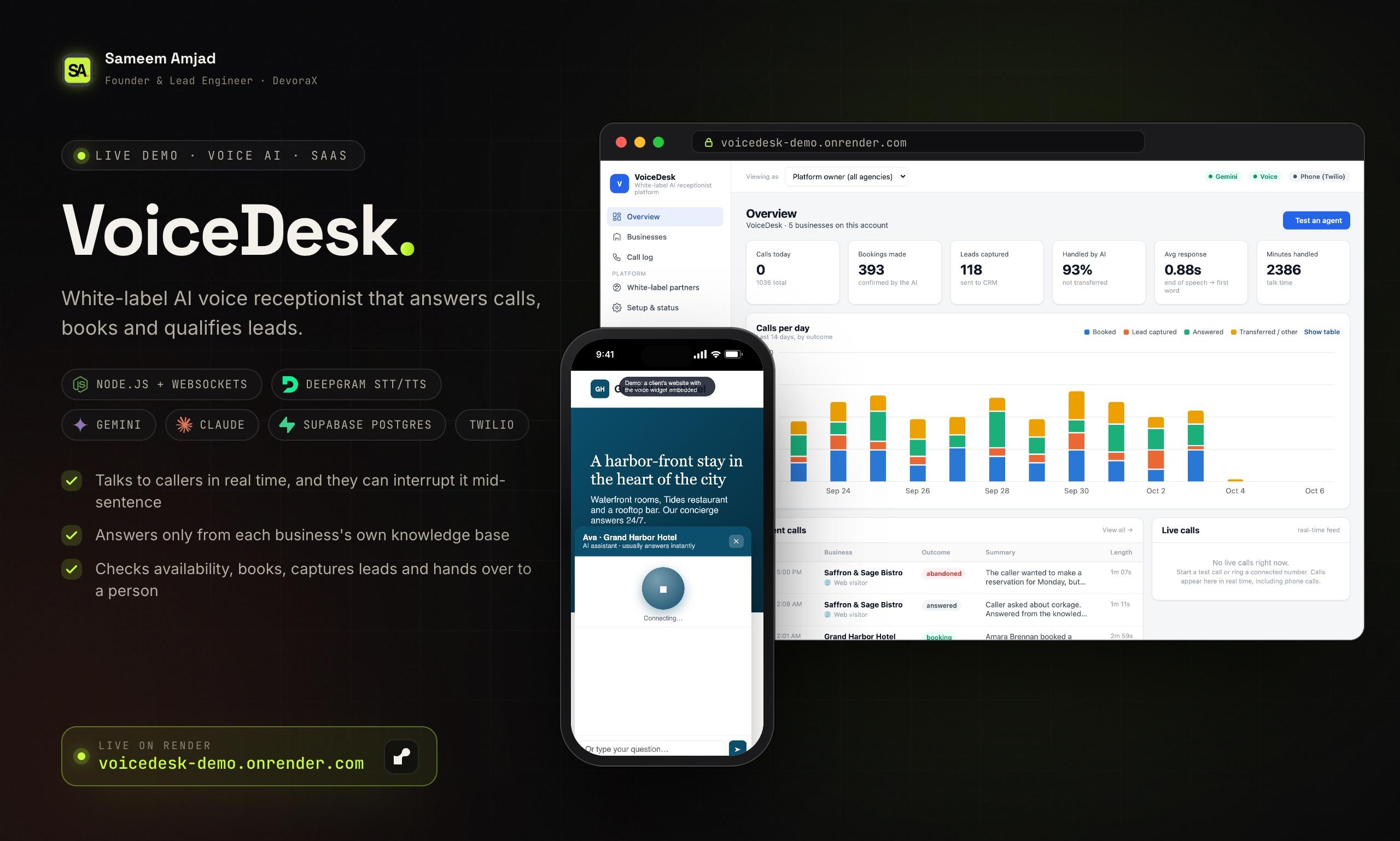
White-label AI voice receptionist that answers calls, books and qualifies leads, for agencies to run under their own brand. A client hired DevoraX through its Fiverr profile, which is in Sameem's name, and Sameem built it as the full-stack engineer.
Facts about the build and who it was for. Any figure here is shown on a public store listing or site linked on this page. See how we present portfolio work.
Walkthrough
Screens
Project Story
Hotels, clinics, restaurants and trades miss calls after hours and at peak times, and every missed call is a lost booking. Agencies want to sell an AI receptionist to these clients, but off-the-shelf tools can’t be rebranded and charge a platform fee on every minute.
Live voice calls in the browser or by phone, which the caller can interrupt mid-sentence; answers drawn only from each business’s own knowledge base; tools for availability, booking with SMS confirmation, lookup and cancel, lead capture, messages and warm transfer; templates for hotel stays, restaurant tables, clinic appointments and service visits; white-label agencies with their own brand and domain; and a live call feed with transcripts, AI call summaries and analytics.
Live demo on sample businesses, with a 3-minute walkthrough recorded on it, including a real voice call.
Project Details
VoiceDesk is a multi-tenant platform where agencies run AI receptionists for their clients under their own brand. Each business gets an agent that talks to callers in real time, answers from its own knowledge base, checks availability, books, captures leads and hands over to a person when needed. A client hired DevoraX through its Fiverr profile, which is in Sameem's name, and Sameem built it as the full-stack engineer: a Node.js and WebSocket voice pipeline with Deepgram speech-to-text and text-to-speech, Gemini (through a Google AI Studio API key) or Claude for the conversation, Twilio for phone calls and Supabase Postgres for the data. The live demo runs on sample businesses and is linked from this page, with a 3-minute walkthrough recorded on it that includes a real voice call.
Tech Stack
Where to See It
Opens the project’s page on the demo hub in a new tab, with any logins the demo needs.
Category
Node.js & Voice AIVoiceDesk is a white-label AI voice receptionist: a multi-tenant platform where agencies run AI receptionists for their clients under their own brand. A client hired DevoraX through its Fiverr profile, which is in Sameem's name, and Sameem built it as the full-stack engineer. Each business's agent talks to callers in real time in the browser or by phone, answers only from its own knowledge base, checks availability, books with SMS confirmation, captures leads and hands over to a person when needed. There is no public live product: the live demo runs on sample businesses on the demo hub, and the 3-minute walkthrough video on this page was recorded on it, including a real voice call.
What you can check
- Live demo on sample businesses: demoprojectsforclients.sameemamjad.com/projects/voicedesk
- A 3-minute walkthrough video on this page, recorded on the live demo, including a real voice call
- No login needed for the demo dashboard; talk to an agent by voice or by typing
Each item points to something public: a store listing, a live site or a demo build. See our terms for how we present portfolio results.
What problem was VoiceDesk built to solve?
Hotels, clinics, restaurants and trades businesses miss calls after hours and at peak times, and for a business that takes bookings by phone, every missed call is a lost booking. An AI receptionist that answers every call, handles the routine questions and bookings, and passes the rest to a person is the obvious remedy.
Agencies want to sell that remedy to these businesses, but off-the-shelf voice-agent tools cannot be rebranded, so the agency's client sees someone else's product, and they charge a platform fee on every minute. VoiceDesk is a multi-tenant platform where agencies run AI receptionists for their clients under their own brand, with an agent for each business that answers from its own knowledge base, books, captures leads and hands over to a person when needed. A client hired DevoraX through its Fiverr profile, which is in Sameem's name, and Sameem built it as the full-stack engineer.
How does a voice turn work, and where does the time go?
A VoiceDesk call passes through a chain of services. In a stack like this one, the caller's audio reaches a Node.js server over a WebSocket, from the browser or, on a phone call, through Twilio. Deepgram turns the speech into text, Gemini or Claude decides what to say and which action to take, and Deepgram turns the reply back into speech. Every stage adds delay, and on a call a long pause feels like a dropped line.
The usual remedy is to make every stage stream rather than wait for the one before it. Recognition produces text while the caller is still talking, the model's reply is read as it is generated, and synthesis can start on the first sentence while the model writes the second. The hardest judgement in the budget is endpointing, deciding that the caller has finished: too eager and the agent talks over someone pausing for breath, too patient and every answer feels sluggish.
How can a caller interrupt the agent mid-sentence?
Interrupting is how people steer a conversation: a caller hears the agent start on the wrong option and says "no, the Thursday". VoiceDesk lets the caller interrupt the agent mid-sentence, known as barge-in, and that shapes the whole pipeline, because the system has to keep listening to the caller while it speaks.
When a system of this kind hears the caller start speaking, several things happen at once. Playback stops, audio already queued for the caller is discarded, and model and synthesis work still in flight is cancelled, so the agent does not resume a sentence the caller has rejected. The conversation history must then keep only the part of the reply the caller actually heard. The hard part is telling a real interruption from noise: a cough, an "mm-hm", or the agent's own voice leaking from a speaker back into the microphone, which is why the demo suggests headphones.
How does the agent answer only from a business's own knowledge base?
A receptionist that invents an answer is worse than one that offers to find out, and language models will produce a plausible check-out time or parking policy if nothing stops them. VoiceDesk's agent retrieves from each business's own knowledge base and answers only from it.
The usual shape of that is retrieval-augmented generation. The business's material, such as hours, services and policies, is held as searchable passages; on each turn the passages most relevant to the caller's question are placed in front of the model, with instructions to answer from them and nothing else. When nothing relevant comes back, the right behaviour is to say so and offer a next step, such as taking a message. On a multi-tenant platform the search must also be scoped to the business taking the call, so one hotel's rates never surface in another's conversation. It also runs inside the turn, so it has to be fast.
How does the agent check availability, book and hand a call to a person?
A receptionist has to act as well as talk, so VoiceDesk gives its agent tools for availability, booking with SMS confirmation, lookup and cancel, lead capture, messages and warm transfer. Gemini and Claude both support tool calling: the model does not act itself, but asks the application to run a named function with structured arguments, then carries on with the result.
The model works out what the caller wants, while the server owns every rule about the real data, such as whether a slot is free and which bookings a caller may look up or cancel. A booking is normally validated again at the moment it is written, because availability can change mid-conversation. The SMS confirmation gives the caller something to read later, lead capture and messages cover calls that are not bookings, and a warm transfer hands the caller to a person with the context already gathered.
How does one engine serve hotels, restaurants, clinics and trades?
VoiceDesk runs one engine for many industries, with templates for hotel stays, restaurant tables, clinic appointments and service visits. On the surface they differ: a hotel stay has dates and a room type, a restaurant table a party size and a time, a clinic appointment a kind of visit and a slot in a schedule, and a service visit an address and a job. Separate receptionists would mean four codebases drifting apart, with each fix made four times.
The alternative is to treat them as one problem: a caller wants to reserve some resource for some time, plus the details it needs. A template supplies what is specific to the industry, such as the details to collect and the agent's instructions, while the voice pipeline, tools and dashboard stay shared. The trade-off is that the common model has to be general enough for all four without becoming so abstract that every industry fights it.
How does white-label multi-tenancy work for agencies?
VoiceDesk is white-label: agencies run it under their own brand and domain, and each agency sees only its own clients. It is a platform with tenants inside tenants: agencies manage client businesses, and each business has its own agent, knowledge base, bookings and calls. Every query and every call event has to carry that ownership, because the failure that matters most here is not a crash but one agency seeing another's clients.
Systems built this way usually work out the tenant from the request itself, including the domain the dashboard is served on, so an agency's clients see the agency's name rather than the platform's. Isolation is safest when enforced close to the data rather than remembered by each feature: Postgres can express ownership as keys and access policies, so a query outside a tenant's scope returns nothing instead of depending on every endpoint to filter correctly.
What does a business see after each call?
VoiceDesk's dashboard has a live call feed, transcripts, AI call summaries with outcome and sentiment, and analytics. A transcript is the complete record, but nobody reads them all, so the summary does the triage: what the caller wanted, what happened and how the call went.
Recording the outcome as a defined category rather than free prose is what makes analytics possible. Whether a call ended in a booking, a lead, a message or a transfer can be counted across days and businesses, whereas paragraphs can only be read. Sentiment does a different job: it points a person at the calls worth listening to, such as a frustrated caller the agent did not help, which is usually where a knowledge base or template needs work. Summaries of this kind are typically produced once a call ends, so they cost the caller no time.
Where can you see VoiceDesk?
VoiceDesk has no public live product to visit or call. The live demo is on the demo hub at demoprojectsforclients.sameemamjad.com/projects/voicedesk, running on sample businesses. No login is needed for the demo dashboard, and the hub page explains how to open a business and test its agent. A voice call needs microphone access, with headphones for the smoothest experience, or you can type to the agent instead. The demo runs on free-tier AI quotas, so the agent can occasionally ask you to try again a minute later.
The walkthrough video on this page is a 3-minute walkthrough recorded on the live demo, including a real voice call. It lets a visitor hear the agent hold a spoken conversation before allowing microphone access and trying the same sample businesses on the demo hub.
Why this stack
- Node.js and WebSockets: a voice call is a long-lived, input-and-output-bound conversation, not a series of requests. It holds a connection open while audio moves both ways and the server waits on recognition, the model and synthesis in turn. Node.js's event loop holds many such connections without a thread for each, and a WebSocket is the full-duplex channel barge-in needs: the server keeps receiving the caller's audio while still sending the agent's.
- Deepgram STT/TTS: streaming speech-to-text and text-to-speech from one provider. Streaming recognition returns text while the caller is still speaking, which lets a system notice an interruption and judge when a turn has ended, and streaming synthesis lets the agent start talking before the whole reply exists. One vendor for both directions keeps the audio formats and failure modes of a voice turn in one place.
- Gemini / Claude: the language model that runs the conversation. A receptionist model has to follow instructions closely, call tools with structured arguments and stream its reply, and both model families do all three. Supporting either keeps the engine from being tied to one provider's pricing, quotas or outages, which matters for a platform that agencies resell. The cost is that prompts and tool definitions must behave consistently on both.
- Twilio: the phone side of the product. Phone numbers and inbound calls come through a telephony provider; Twilio can stream a call's audio to an application over a WebSocket, which is what lets a phone call and a browser call share one pipeline. Telephony providers such as Twilio also offer SMS and call transfer, the kind of actions behind a booking confirmation by text and a warm transfer to a person.
- Supabase Postgres: the data in a product like this is relational and tenant-shaped. Agencies have businesses; businesses have agents, knowledge bases, bookings and calls; calls have transcripts and summaries. Postgres keys and constraints enforce those references, aggregate queries answer dashboard questions such as outcomes per business over a week, and access policies can hold tenant boundaries close to the data. Supabase runs the database as a managed service.