iDecorwala
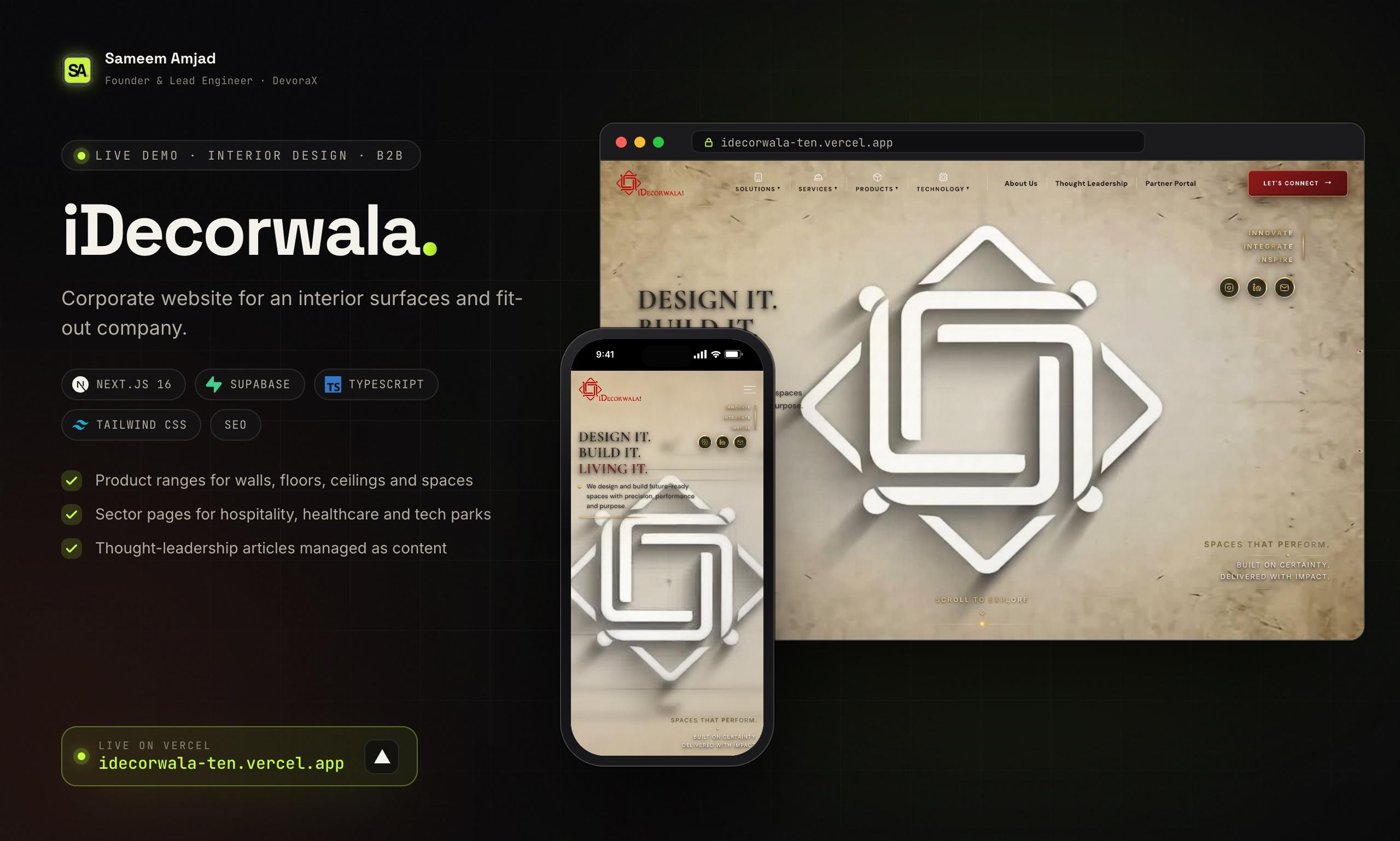
Corporate website for iDecorwala, a company supplying wall, floor and ceiling finishes and modular spaces. Sameem built it as the full-stack engineer for iDecorwala. Live at idecorwala.com.
Facts about the build and who it was for. Any figure here is shown on a public store listing or site linked on this page. See how we present portfolio work.
Walkthrough
Screens
Project Story
The business needed a credible B2B website that presents its product ranges, ranks in search, and turns visitors into project enquiries, with content the team can update without a developer.
Product categories and product pages driven from the database; thought-leadership articles, projects and services pages; a contact and request-for-proposal flow; and SEO foundations: metadata, a sitemap and fast server-rendered pages.
Live at idecorwala.com.
Project Details
iDecorwala’s corporate website is a fast, search-optimised site for a company supplying wall, floor and ceiling finishes and modular spaces, with product ranges and articles managed as content. Sameem built it as the full-stack engineer for iDecorwala, on Next.js 16 and Tailwind CSS, with product categories, products and articles stored in Supabase so the team can update them without a developer. The site is live at idecorwala.com, and a 75-second walkthrough of it is on this page.
Tech Stack
Where to See It
Opens the project’s page on the demo hub in a new tab, with any logins the demo needs.
Category
Next.js & SupabaseiDecorwala's corporate website is a fast, search-optimised B2B site for a company supplying wall, floor and ceiling finishes and modular spaces. Sameem built it as the full-stack engineer for iDecorwala. It runs on Next.js 16, TypeScript and Tailwind CSS, with product categories, products and articles stored in Supabase so the team can update them without a developer, plus projects and services pages, a contact and request-for-proposal flow, and SEO foundations of metadata, a sitemap and server-rendered pages. It is live at www.idecorwala.com, and a 75-second walkthrough of the live website is on this page.
What you can check
- Live site, no login needed: www.idecorwala.com
- Project page on the demo hub: demoprojectsforclients.sameemamjad.com/projects/idecorwala
- A 75-second walkthrough video of the live website on this page
- Product ranges for walls, floors, ceilings and spaces, and sector pages for hospitality, healthcare and tech parks
Each item points to something public: a store listing, a live site or a demo build. See our terms for how we present portfolio results.
What problem was the iDecorwala website built to solve?
iDecorwala supplies wall, floor and ceiling finishes and modular spaces, and its live homepage describes the business as tech-first institutional, interiors, EPC, PMC and design work. The business needed a credible B2B website that presents its product ranges, can be found in search, and turns visitors into project enquiries, with content the team can update without a developer.
Each requirement pulls on a different part of the build. Credibility depends on how complete and consistent the site looks to a buyer deciding whether to shortlist a supplier. Product ranges mean structured content that grows and changes. Search means pages a crawler can read in full. Enquiries mean a clear route from any page to a conversation.
The last requirement constrains the others. If every new product or article needs a developer, the site falls behind the business, and an out-of-date corporate site undermines the credibility it exists to provide. The central design decision was therefore to separate the content the team changes from the code that presents it.
How is the iDecorwala site organised for B2B buyers?
A buyer furnishing a hotel, a hospital or a tech park rarely arrives looking for one product. They arrive with a project and want to know whether the supplier understands that kind of building, what it can supply, and whether it has done similar work.
The iDecorwala site answers in layers: product ranges for walls, floors, ceilings and spaces; sector pages for hospitality, healthcare and tech parks; services pages; projects; thought-leadership articles; and a contact and request-for-proposal route. That gives a visitor two ways in: by what they need to buy, through the ranges, or by the kind of building they are working on, through the sector pages.
The structure serves search as well as people. Each layer is a set of pages with its own subject, which gives a search engine, or an AI engine summarising suppliers, a distinct page to match each distinct question, rather than one long page that matches everything weakly.
Why are the product categories and product pages driven from the database?
Product categories and product pages on the site are driven from the database: categories, products and articles are stored in Supabase, so the team can update them without a developer. The alternative, product copy written into page code, works until the range changes and every new finish becomes a development task.
The content has a natural shape. A category such as walls contains many products, each product belongs to a category, and both need a stable web address. That is relational data, and Supabase's data layer is Postgres, so the relationship can be held as a key between two tables. A page template then presents whichever category or product the address names, so adding a product is a data change rather than a code change.
The trade-off is that the database becomes part of the editorial process. Fields the design depends on, such as an image, a summary or the address slug, have to be present and well formed, so systems of this kind usually rely on required columns and sensible defaults to stop an incomplete entry producing a broken page.
Why do server-rendered pages matter for search and for AI crawlers?
Fast server-rendered pages are one of the site's SEO foundations, and the reason is who reads a page. A browser runs JavaScript and can assemble a page after it loads. Many crawlers do not, or do so later: Google renders JavaScript in a separate, deferred pass, and many crawlers that feed AI answer engines read only the HTML they are first sent. A page whose content is fetched in the browser can look complete to a visitor and nearly empty to a crawler.
Server rendering closes that gap. The server sends HTML with the headings, copy, links and metadata already in it, so every reader receives the same page. Next.js makes this a decision per route: a page can be rendered on the server per request, generated ahead of time, or rendered in the browser where interactivity matters more than indexing.
The usual rule for a corporate site follows: anything meant to be found, such as product ranges, sector pages and articles, should arrive as complete HTML, and only genuinely interactive pieces should depend on the browser.
What do the site's SEO foundations consist of?
The site's SEO foundations are metadata, a sitemap and fast server-rendered pages. They do not make a site rank, but without them good content is harder to find and easier to misread. This study makes no claim about rankings or traffic.
Metadata is a page's description of itself: a title, a description and usually a canonical address, so search results show the right words and duplicate addresses resolve to one page. On a database-driven site the sound pattern is to generate it from the content that fills the page, so a new product or article gets a correct title without anyone writing tags by hand. On 19 October 2026 the live homepage title was "iDecorwala | Tech-First Institutional, Interiors, EPC, PMC & Design."
A sitemap lists the addresses a site wants crawled, which helps search engines reach deep pages, such as an individual product range, that few other sites link to. Speed matters to crawlers as it does to people: a page that arrives quickly as finished HTML is cheaper to crawl.
Why are the articles, projects and services pages treated as content?
Alongside the product ranges, the site carries thought-leadership articles, projects pages and services pages, and the articles are stored in Supabase with the products rather than written into code.
Each page type does a different job for a B2B buyer. Services pages explain what the company does beyond supplying surfaces. Projects pages are proof, because completed work is the evidence a procurement team looks for before shortlisting anyone. Articles answer the questions buyers ask before they are ready to talk to a supplier, and they are the kind of page a search engine or AI engine can quote.
Articles are the content added most often, so they gain the most from being data. An article held as a record with a title, a summary, a body and a published state can be prepared and published by the team without a developer. Systems of this kind usually store the body as structured parts, such as headings, paragraphs, images and quotes, so every article appears in one house style rather than formatted differently by each author.
What does the contact and request-for-proposal flow have to do?
Turning visitors into project enquiries was part of the brief, and the site handles it with a contact and request-for-proposal flow. The two serve different visitors: a contact route suits someone with a quick question, while a request for proposal suits a buyer with a project, who expects to describe the scope, sector and location.
For a fit-out business the request-for-proposal form is a qualification tool as much as a contact form. Its fields decide whether the first conversation starts from a clear brief or from a round of basic questions, so the usual approach is to ask for what is needed to route and price an enquiry and little more, because every extra field costs completed submissions.
Behind any form like this, the engineering questions are ordinary but easy to get wrong: validating input on the server as well as in the browser, keeping out spam without adding friction, confirming a submission clearly, and making sure every enquiry reaches a person.
Where can you see iDecorwala?
The site is live at www.idecorwala.com, and as a public website it needs no login. A visitor can browse the product ranges for walls, floors, ceilings and spaces, the sector pages for hospitality, healthcare and tech parks, the services and projects pages, the thought-leadership articles, and the contact and request-for-proposal route.
The project also has a page on the demo hub at demoprojectsforclients.sameemamjad.com/projects/idecorwala, which sets out the problem, the solution and the stack, shows screenshots and links to the website. It needs no login either: this is a public corporate site, not an application with accounts.
The video on this page is a 75-second walkthrough of the live website, for a quick tour before visiting. What neither the site nor the video shows is the content side: the product categories, products and articles the team maintains in Supabase, which is the part of the build that lets the site keep pace with the business without a developer.
Why this stack
- Next.js 16: a corporate site needs pages that search engines and AI crawlers can read in full, and Next.js renders React on the server so a page can arrive as finished HTML with its metadata in place. Its file-based routing suits a site with many page types, and dynamic routes let one template serve every product or article stored in the database. Each route can choose server rendering, generation ahead of time or browser rendering, and the framework has built-in support for page metadata and a generated sitemap.
- Supabase: it stores the product categories, products and articles, which is what lets the team update them without a developer. Its data layer is Postgres, which suits content with real relationships, such as products that belong to categories, and its dashboard lets structured records be edited directly. As a managed service it adds no database server for a company website to look after.
- TypeScript: on a content-driven site the main risk is a mismatch between what the database holds and what a page expects, such as a missing image or a renamed field, and that mismatch shows up as a broken page rather than an error. Typing the shapes of categories, products and articles lets the compiler flag a template that reads a field that does not exist. That matters more as content is edited by people who never see the code.
- Tailwind CSS: a corporate site is judged on consistency, because a buyer reads uneven spacing or mismatched type as carelessness. Tailwind expresses a design system as a fixed scale of spacing, colour and type applied through utility classes, so a new section is assembled from the same values as the rest of the site rather than from one-off CSS. Styles sit with the components that use them, which keeps the stylesheet from growing with every page, and unused classes are left out of the build.