SolNotary
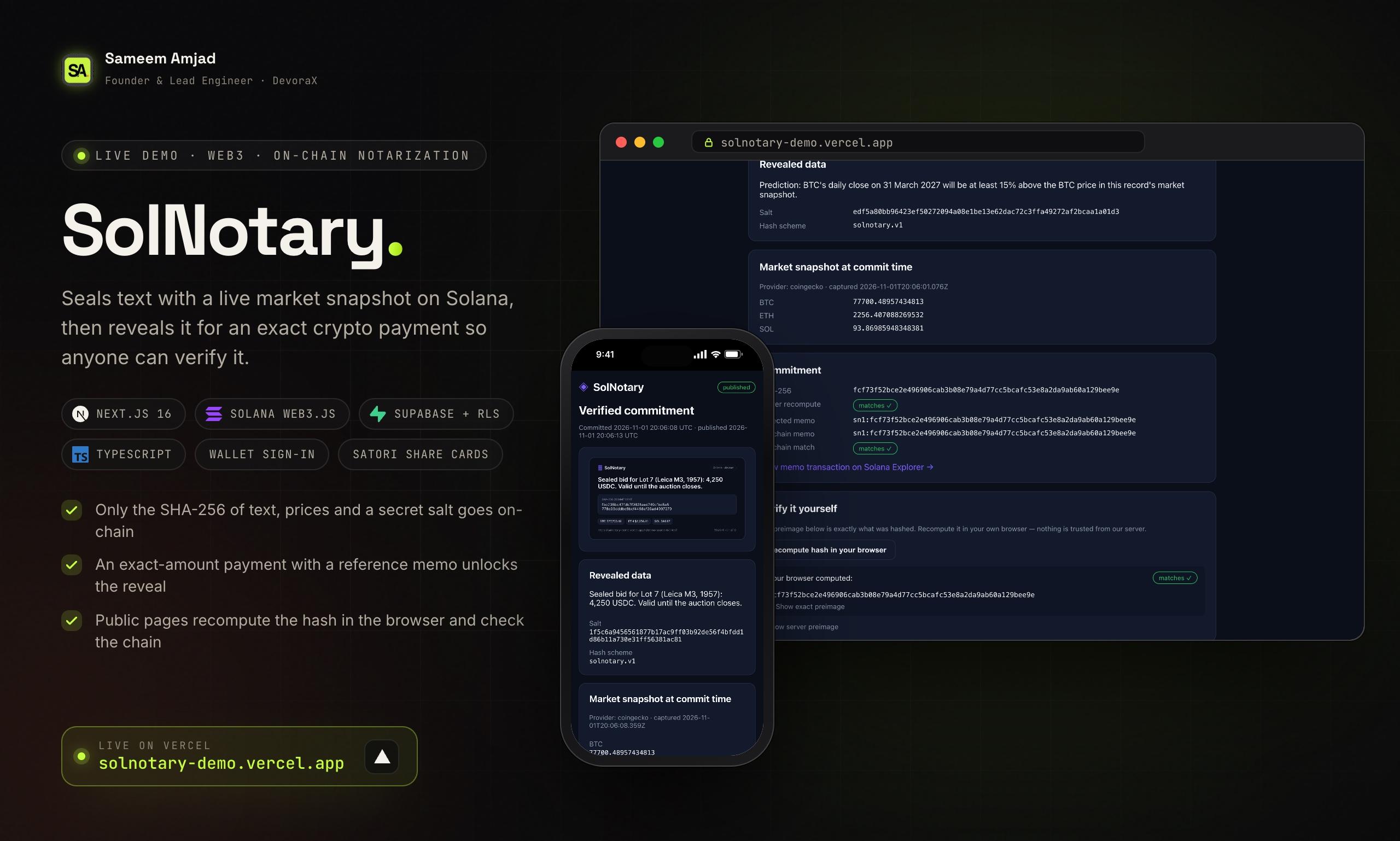
On-chain notarization with a paid reveal: a text is sealed on Solana as a hash and published for an exact crypto payment. A client project: Sameem worked on it as a full-stack engineer.
Facts about the build and who it was for. Any figure here is shown on a public store listing or site linked on this page. See how we present portfolio work.
Walkthrough
Screens
Project Story
Predictions, sealed bids and ideas are only worth something if you can prove later that they came first, without giving them away early. Screenshots and emails can be faked, and posting the text publicly reveals it. The client wanted a commitment that a public blockchain can vouch for, fast and cheap, with publishing as the paid step.
Sign-in by wallet signature, a one-time challenge checked with ed25519 on the server, with no passwords or email; the text, a market snapshot and a secret salt hashed with SHA-256, with only the hash written to Solana as a memo transaction confirmed in seconds; unlock by an exact payment in SOL, USDC or USDT with a reference memo, matched by webhook or by checking the transaction on-chain; public pages that reveal the text and salt and recompute the hash in the visitor's own browser; share cards rendered on the server; row-level security that keeps sealed records unreadable with the public key; and a read-only admin overview that never shows sealed text.
Live demo on Solana devnet, where every transaction is real but uses test SOL with no value, with a 2-minute walkthrough recorded on it.
Project Details
SolNotary proves what someone knew, and when, without revealing it early. A signed-in Solana wallet submits a short text; the server adds a live BTC, ETH and SOL price snapshot and a secret salt, hashes them with SHA-256 and writes only the hash to Solana as a memo transaction. Paying an exact amount later publishes the text on a public page that recomputes the hash in the visitor's browser. It is a client project: Sameem worked on it as a full-stack engineer, on Next.js 16 with Solana web3.js and Supabase. The live demo runs on Solana devnet with test SOL, and a 2-minute walkthrough recorded on it is on this page.
Tech Stack
Where to See It
Opens the project’s page on the demo hub in a new tab, with any logins the demo needs.
Category
Next.js & SolanaSolNotary is a web app for proving what someone knew, and when, without revealing it early. SolNotary is a client project: Sameem worked on it as a full-stack engineer for a client. A user signs in with a Solana wallet signature and submits a short text, such as a prediction or a sealed bid. The server adds a BTC, ETH and SOL price snapshot and a secret salt, hashes them with SHA-256 and writes only the hash to Solana as a memo transaction, confirmed in seconds. Paying an exact amount in SOL, USDC or USDT with a reference memo later publishes the text on a public page, where the visitor's own browser recomputes the hash and compares it with the chain. A devnet demo using test SOL is at demoprojectsforclients.sameemamjad.com/projects/solnotary, and a 2-minute walkthrough is on this page.
What you can check
- Live demo on Solana devnet: demoprojectsforclients.sameemamjad.com/projects/solnotary (a demo wallet, a verified record and the read-only admin overview)
- A 2-minute walkthrough video on this page: a verified record, a new notarization paid with test SOL, and the admin overview
- Every demo transaction is real on devnet and opens in Solana Explorer; the test SOL has no value
Each item points to something public: a store listing, a live site or a demo build. See our terms for how we present portfolio results.
What problem was SolNotary built to solve?
Predictions, sealed bids and ideas only count if their author can prove later that they came first, yet stating them early gives them away. Screenshots and emails can be faked, and posting the text publicly to fix its date reveals it.
The client wanted a commitment that a public blockchain can vouch for, fast and cheap to make, with publishing as the paid step. SolNotary is a client project: Sameem worked on it as a full-stack engineer for a client.
In SolNotary a signed-in wallet seals a short text, Solana records its fingerprint within seconds, and an exact payment later reveals the text on a public page anyone can check.
One plain caveat: a hash on a blockchain proves that a text existed at a certain time. It is not a legal notarization, and nothing here claims legal validity.
How does a commit-reveal scheme prove a text came first?
Commit-reveal is an established pattern in cryptography. To commit, you publish a hash of your message: a short fingerprint produced by a function such as SHA-256. The hash reveals nothing, yet it is bound to the message, because finding another message with the same hash is computationally infeasible. Revealing the message later lets anyone hash it again and see that it matches.
A hash on its own carries no date. The date comes from where it is published. A transaction on a public blockchain sits in a timestamped block, so the transaction proves the text existed no later than that moment, and nobody, the app's operator included, can backdate or edit it afterwards.
If the text is short and predictable, say a yes-or-no call on a price, an observer could hash every likely candidate and compare, so commit-reveal schemes mix in a secret random value, a salt, and reveal it with the message. SolNotary generates a fresh salt for every record.
What exactly does SolNotary hash, and why add market prices?
Each record's hash covers a scheme version, the user's text, a snapshot of market prices and the salt. The prices are BTC, ETH and SOL, fetched when the text is submitted. The snapshot puts the market context inside the sealed entry: a published price call can be read against the prices that stood when it was sealed, and those numbers cannot be swapped later without changing the hash.
To recompute a hash, both sides must feed the function exactly the same bytes, and JSON does not guarantee that, since two programs can order keys or format numbers differently. SolNotary serialises the bundle deterministically, with sorted keys, prices kept as text rather than floating-point numbers, and ambiguous values rejected.
The scheme's name is stored with every record and shown on its public page, the usual way to keep older records checkable if a format ever changes.
Why does only a hash go on Solana, and why as a memo?
Solana's Memo program attaches a short text note to a transaction. The note is stored in the ledger, public and permanent, and block explorers display it, so a commitment needs no custom on-chain program.
SolNotary's memo is a short, recognisable prefix followed by the hash. The text itself never goes on-chain.
The app's own notary wallet signs and pays for the memo transaction, so the user needs no SOL to seal a record. That makes the notary wallet's balance worth protecting, and the server caps how many records one wallet can seal per hour.
Ordering matters when a database and a blockchain must agree. The server saves the sealed record before sending the transaction and stores the signature before waiting for confirmation, so a request cut short leaves a record that can be reconciled rather than lost.
How does signing in with a wallet replace passwords?
SolNotary has no passwords and collects no email. A Solana wallet address is an ed25519 public key, so a wallet proves who it is by signing a message with the matching private key.
Following the sign-in-with-Solana pattern, the server issues a single-use nonce that expires within minutes, inside a readable message naming the site and the wallet. The wallet signs it, and the server rebuilds the message itself and checks the signature against the wallet's public key.
Consuming the nonce on first use stops a captured signature from being replayed, and because the server rebuilds the message with its own domain, a signature collected by a look-alike site fails. A verified signature earns a signed session in an httpOnly cookie, which scripts on the page cannot read. Admin rights come from a list of wallets held on the server.
How does an exact payment publish the text?
The owner of a sealed record picks SOL, USDC or USDT, and the server returns an exact amount, a deposit address and a reference to include as a memo in the payment.
This is a common way to accept crypto without a payment processor: the reference ties the transfer to one record, and an exact amount leaves no judgement about whether a payment was close enough. SolNotary does this arithmetic in whole numbers of each asset's smallest unit, lamports for SOL, because floating-point numbers can make an exact amount approximate.
A webhook authenticated with a shared secret can report incoming transfers, each recorded only once, keyed by its signature. Alternatively, the app checks a given transaction on-chain: it must carry the reference memo and credit the deposit address by exactly the expected amount, and a failed transaction never counts. A match publishes the record.
How can a visitor check a record without trusting the server?
A published record has a public page showing the text, the salt, the market snapshot, the hash and a link to the memo transaction in Solana Explorer. The server recomputes the hash and reads the memo back from the chain, and the page shows whether each matches.
A server-side check still asks the visitor to trust the server, so the page also offers a button that recomputes the hash in the visitor's own browser. The same hashing code runs on the server at sealing time and in the browser here, through the browser's built-in Web Crypto API, and the page can display the exact input that was hashed. Comparing the result with the memo in the explorer needs nothing from SolNotary.
Each public page also has a share card, an image rendered on the server with the text, the hash and the prices, used as the link preview when the page is shared.
How are sealed records kept private?
Until a record is published, its text and salt are the secret. Data lives in Supabase Postgres with row-level security on every table and no access by default. The only public path is a policy letting the public key read published records, plus a column-level grant limiting even those to public fields, so internal fields such as the payment reference stay on the server.
Every other read and write goes through the Next.js server, which checks the wallet session before using a privileged key that never reaches the browser. Because the rule lives in the database, a mistake in one page or API route cannot expose a sealed record through the public key.
The admin overview lists records and payments with their statuses and hashes but never selects the text or the salt, so a sealed record stays sealed even from the people running the app. DevoraX holds no security or compliance certifications.
Where can you see SolNotary?
The demo runs on Solana devnet, a public test network, from the demo hub at demoprojectsforclients.sameemamjad.com/projects/solnotary. Every transaction is real and opens in Solana Explorer, but it uses test SOL that has no value. Devnet has no USDC or USDT, so the demo takes SOL only.
A visitor needs no wallet. “Use a demo wallet” creates one in the browser that signs in like Phantom and is kept there. After sealing a text, the visitor can pay to publish it: the demo tops the wallet up with exactly the test SOL needed, so the payment is a real devnet transaction. Phantom also works, switched to devnet. “Sign in as the demo admin” opens the read-only overview of every record and payment, which never shows sealed text. The hub page also links to a verified record.
This page also carries a 2-minute walkthrough showing a verified record, a new notarization paid with test SOL, and the admin overview.
Why this stack
- Next.js 16 + React 19: one codebase holds the public pages, the signed-in app and the API routes. Route handlers run on the server, where the notary wallet's key must stay, and modules marked server-only fail the build if browser code imports them. Public record pages render on the server with their share-card metadata, while React client components handle the wallet steps and the in-browser recompute.
- TypeScript: the commitment format is a contract between the server that seals a record and every browser that checks it later, so one typed module builds the hashed input on both sides. Request bodies are also validated at runtime with zod, so malformed input stops at the edge of each API route.
- Solana web3.js (memo transactions): the standard JavaScript client for Solana, used to send memo transactions from the notary wallet, confirm them within a deadline, and read transactions back to check memos and balance changes. Solana suits the product because transactions confirm in seconds at low cost.
- Supabase Postgres + RLS: users, sign-in nonces, records and payments are relational and need constraints such as a unique payment reference and a unique transaction signature. Row-level security lets the database itself decide that only published records are readable with the public key, the property the whole product depends on.
- Wallet-signature sign-in: people who use apps of this kind usually hold a Solana wallet already, so the wallet doubles as the account. An ed25519 signature over a single-use challenge leaves no passwords to store or reset.
- satori + resvg cards: satori turns a React-style layout into SVG and resvg renders that SVG to PNG, on the server and without a headless browser. That keeps card rendering light, and bundled fonts make every card look the same.