ExpertProfile.AI
Expert-recognition website that publishes lists of verified experts, run from a no-code CMS. A client project: Sameem worked on it as a full-stack engineer.
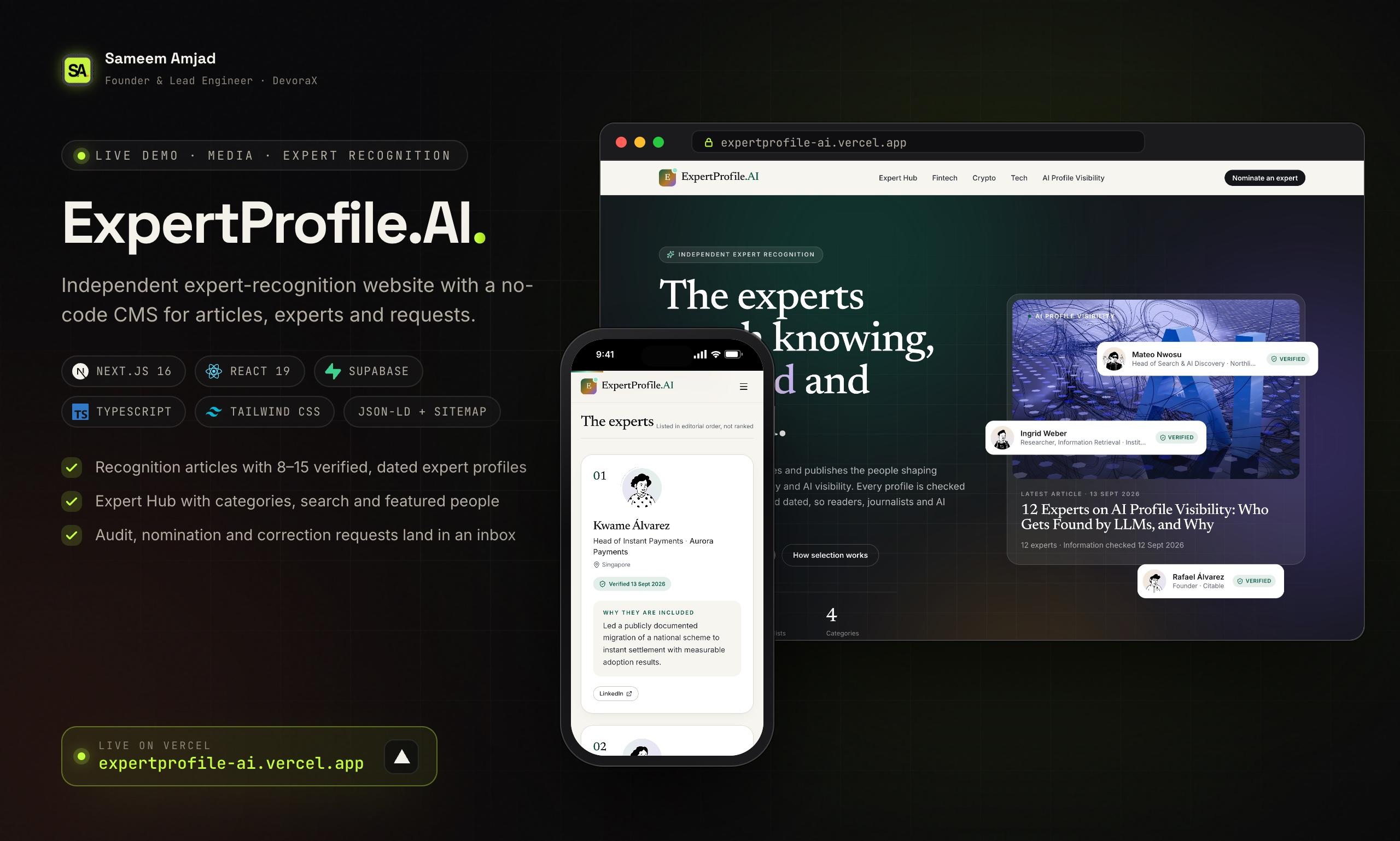
Facts about the build and who it was for. Any figure here is shown on a public store listing or site linked on this page. See how we present portfolio work.
Walkthrough
Screens
Project Story
When people ask an AI assistant or a search engine who the experts are on a topic, the answer depends on what public sources say, and those sources are often thin, outdated or wrong. Experts and companies have no trustworthy, well-structured page that vouches for them, and the editorial team needs to publish and maintain one without a developer.
Recognition articles on one template: topic, date, geography, introduction, 8–15 expert cards and the methodology; expert cards with the role, organisation, reason for inclusion, public links and the date the information was checked; an Expert Hub with category tabs and counts, featured people and search; AI Profile Audit requests, nominations and correction requests that land in the editors' inbox; a no-code CMS for articles and experts, categories, events, pages, the inbox, newsletter subscribers and team roles; and pages generated ahead of time that refresh the moment something is published, with JSON-LD and a sitemap.
Live demo on sample data: the public website and the CMS, where a published article appears on the site within seconds, with a 2½-minute walkthrough recorded on it.
Project Details
ExpertProfile.AI is an editorial website that publishes lists of verified experts in fintech, crypto, technology and AI visibility. Each article names 8–15 people with their role, why they were included, public links and the date the information was checked, and the whole site is run from a no-code CMS. It is a client project: Sameem worked on it as a full-stack engineer, on Next.js 16 and React 19 with Supabase for content, sign-in and images, behind row-level security. The live demo is linked from this page, with a 2½-minute walkthrough recorded on it.
Tech Stack
Where to See It
Opens the project’s page on the demo hub in a new tab, with any logins the demo needs.
Category
Next.js & SupabaseExpertProfile.AI is an editorial website that publishes lists of verified experts in fintech, crypto, technology and AI visibility, run from a no-code CMS. ExpertProfile.AI is a client project: Sameem worked on it as a full-stack engineer for a client. Each recognition article names 8–15 people, with their role, organisation, reason for inclusion, public links and the date the information was checked. Readers browse an Expert Hub with category tabs and search, and can send AI Profile Audit requests, nominations and corrections to the editors' inbox. Editors run articles, experts, categories, events, pages, newsletter subscribers and team roles without a developer, and published content appears on the site within seconds. The site and the CMS can be tried at demoprojectsforclients.sameemamjad.com/projects/expertprofile, and a 2½-minute walkthrough is on this page.
What you can check
- Live demo on sample data: demoprojectsforclients.sameemamjad.com/projects/expertprofile (the public website and the CMS)
- A 2½-minute walkthrough of the website and the CMS on this page, recorded on the demo data
- Publishing the demo draft “8 Rising Voices in Open Banking” puts it in the Expert Hub within seconds
Each item points to something public: a store listing, a live site or a demo build. See our terms for how we present portfolio results.
What problem was ExpertProfile.AI built to solve?
When people ask an AI assistant or a search engine who the experts are on a topic, the answer depends on what public sources say, and those sources are often thin, outdated or wrong. Experts and companies usually have no trustworthy, well-structured page that vouches for them.
ExpertProfile.AI sets out to be that page: an independent editorial site that lists experts, says why each person was included and dates the details, in a form people and machines can both read. It makes no promise about how any search engine or assistant will use it.
The other half of the problem belongs to the editorial team. A publication like this is only as good as its upkeep, because people change roles and lists go stale, so the team needs to publish and correct it without a developer. Hence the two parts: a public website and the no-code CMS behind it.
What goes into a recognition article?
Every recognition article follows one template: a topic, a date, a geography, an introduction, 8–15 expert cards and the methodology. A fixed template keeps the publication consistent between editors.
Each expert card shows the person's role, organisation, reason for inclusion, public links and the date the information was checked. The reason for inclusion is the editorial core of the card: it says why the person belongs on the list. The date checked tells the reader how fresh the details are, and the article carries its own "Information checked" date near the title.
The page also has a contents list that jumps to each expert, share links and a corrections and nominations section at the end, so a reader who spots an error knows where to say so. Publications of this kind usually print their methodology so readers can judge the selection.
How does the Expert Hub help readers find people?
The Expert Hub is the site's index. Each category tab shows a count of published articles, so a reader can see how much the hub holds in fintech, crypto, technology or AI visibility before choosing. Article cards show featured people from each list, and a search box looks across the titles and summaries of published articles. The homepage shows recently recognised experts and upcoming events.
Search results are kept out of search engines on purpose: the robots file asks crawlers to skip the search page, a common practice because every query produces another near-duplicate page.
How does the no-code CMS let editors run the site without a developer?
The CMS sits behind a sign-in at /admin and covers what an editor would otherwise ask a developer to change: articles and their experts, categories, events, pages, the inbox, newsletter subscribers and team roles.
The article editor holds the whole template in one form. Experts are added as repeating cards, each with a photo upload, public links and the date checked. Longer text is written in Markdown with a formatting toolbar and a preview, and images upload straight to storage from the form.
An article can be saved as a draft, published or archived. Before anything goes live, the CMS checks the essentials: a valid URL slug, a short summary for the article cards, at least one expert and links that start with http or https. Checks like these let the form catch mistakes a developer would otherwise catch in review.
Events and pages such as About, Privacy and Terms are edited in the same way.
How does a published article appear on the site within seconds?
The public pages are generated ahead of time. Next.js renders the homepage, the hub, each category and each article from the database and serves ready-made HTML, so a visit does not wait on a database query. That is the usual approach for editorial sites, which are read far more often than they change.
The catch is freshness: a page built earlier knows nothing of an article published a minute ago. Next.js answers this with on-demand revalidation. When an editor saves or publishes, the server action that writes to the database also tells Next.js to discard its cached pages, and the next request rebuilds them from current data. Because the site is small, a save refreshes the whole public site instead of tracking which page shows which article, so the homepage, hub, category pages and sitemap stay in step. A timed refresh sits behind it as a fallback.
In the demo, publishing the draft “8 Rising Voices in Open Banking” puts it in the Expert Hub within seconds.
What do JSON-LD and the sitemap tell search engines and AI assistants?
JSON-LD is structured data in the schema.org vocabulary, embedded in a page as a small block of JSON. Search engines read it to learn what a page is about without inferring it from the layout.
Each ExpertProfile.AI article describes itself as an Article with its headline, dates, author, publisher and section. Its subject is an ordered list of people, each marked up with a name, a job title, an employer and public profile links as sameAs references. That mirrors the expert card: the facts a reader sees are restated in a form a machine can parse.
The sitemap lists the homepage, the hub, every category and every published article and page, with modification dates, and the robots file points crawlers to it while keeping the CMS out. Neither guarantees that any search engine or assistant will show or cite a page, and the site makes no such claim.
How do readers' requests reach the editors?
The site has forms for an AI Profile Audit request, a nomination, a correction and the newsletter. The first three land in the CMS inbox, where an editor can filter them by kind and mark each one new, reviewed or closed. Corrections and nominations sent from the end of an article record which article they concern, and newsletter sign-ups have a Subscribers tab of their own.
Against spam, the forms carry a hidden field that people never see but simple bots tend to fill in, a common low-friction alternative to a CAPTCHA. The database adds its own rules: an anonymous visitor may only add a well-formed request of a known kind, and can never read the inbox back.
In the demo the forms really reach the demo inbox, so the hub page asks visitors to use made-up details.
How are editors, viewers and the public kept apart?
The CMS has three roles. Editors create, edit and publish content. Admins can also change roles on the Team page. Viewers can sign in but cannot edit, and the CMS tells them to ask an admin for access.
The roles are enforced in the database as well as the interface. Supabase is built on Postgres, and every table uses row-level security: policies decide, on each query, what the person asking may read or write. The public can read articles, events and pages only once they are published, and an article's experts likewise, so a draft and its expert list stay private until it is published, whichever route a request takes. Image uploads are limited to editors by the same check.
The CMS pages are marked so that search engines do not index them. DevoraX holds no security or compliance certifications.
Where can you see ExpertProfile.AI?
ExpertProfile.AI is a client project: Sameem worked on it as a full-stack engineer for a client. The public demo is a separate copy on sample data, reset regularly, so its experts and articles are illustrations. The website and the CMS can both be tried from demoprojectsforclients.sameemamjad.com/projects/expertprofile, and the hub page lists the demo logins for an admin, an editor and a viewer.
On the website a visitor can browse the Expert Hub by category, search it, read an article with its expert cards and methodology, and send a request through the forms. In the CMS, the suggested path is to publish the draft “8 Rising Voices in Open Banking” and then open the Expert Hub, where it appears within seconds. None of the demo accounts can delete data or change roles.
This page also carries a 2½-minute walkthrough of the website and the CMS, recorded on the demo data.
Why this stack
- Next.js 16 + React 19: Next.js renders the public site ahead of time and serves static HTML. On-demand revalidation lets a published article replace the cached pages within seconds, and server actions keep the CMS's saves on the server beside that call. The Next.js 16 request hook, the proxy, runs only on CMS routes to keep the editor's session current, so public pages never pass through it.
- TypeScript: an article is a nested record, with a category, a list of experts and each expert's links, and the CMS form, the save action, the public page and the JSON-LD all share that shape. Typing it once turns a renamed or removed field into a compile error rather than a gap on a published page.
- Supabase Postgres + Auth + Storage: a managed Postgres database with sign-in and file storage in one platform. The content is relational, with articles, their experts, categories, events and inbox items referring to one another, and Postgres expresses that with keys and constraints. Auth provides the CMS sign-in, and Storage holds the hero images and expert photos uploaded from the editor.
- Row-level security: Postgres policies that decide on every query which rows a person may read or change. The public site and the CMS share one database, so putting the rules there keeps drafts private and limits anonymous forms to well-formed requests, whichever page sends the query.
- Tailwind CSS: utility classes keep one editorial design consistent across the public site and the CMS without a stylesheet per component. Colour tokens such as ink, paper and the accent are defined once and reused, which suits a site whose articles all share one template.
- JSON-LD + sitemap: the standard ways to describe a site's content to automated readers. JSON-LD states each article's subject as a list of people with job titles, employers and public profile links, and the sitemap lists every public address with modification dates. Both are generated from the database, so a newly published article is described and listed without manual work.